

Legislation hits close to home for MHS students
Katie Samol | The Chronicle
From the privacy of doctors’ offices to the common space of classrooms, a wave of legislation is redrawing the boundaries of LGBTQ+ life in America.
According to the American Civil Liberties Union, 393 bills targeting transgender healthcare, education, school facilities and personal expression have been introduced, advanced or passed into law nationwide as of 2026. This movement has now arrived at the Ohio Statehouse, placing the rights of thousands of Ohioans at the center of a national political debate.
For Rose Crissman, a sophomore at Mason High School (MHS) who is a transgender girl, recent legislation has become personally impactful.
“I would say in the recent months and years, there has been a large onslaught of rapid attacks to try to get anti-LGBTQ and anti trans things passed,” Crissman said. “I think a lot of [legislators] are doing rapid and harsh bills to get discrimination through.”
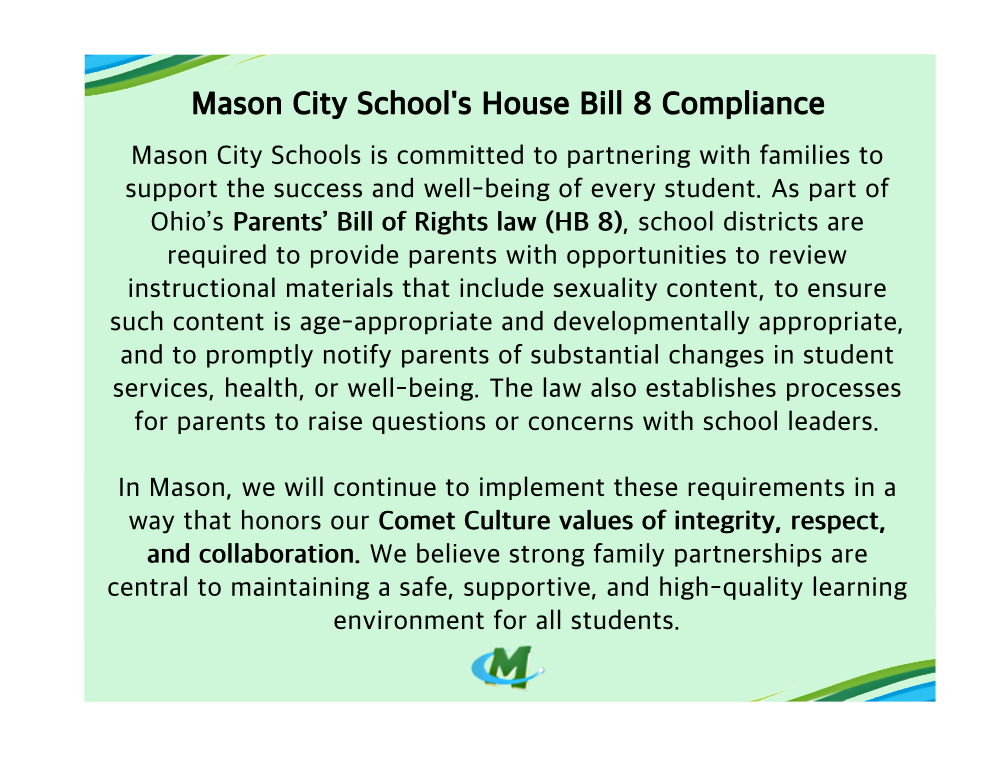
On April 9, 2025, Ohio House Bill 8 (HB8) went into effect, requiring public schools to adopt policies regarding parental notification, curriculum review and student health information. School districts were expected to develop and adopt a policy compliant with the bill by July 1, 2025. HB8 states that schools must notify parents of changes in their child’s physical, emotional or mental health. Critics of this bill argue that this policy means that districts are required to “out” students to parents, even if the student is not comfortable sharing their gender or sexual identity with their guardian.
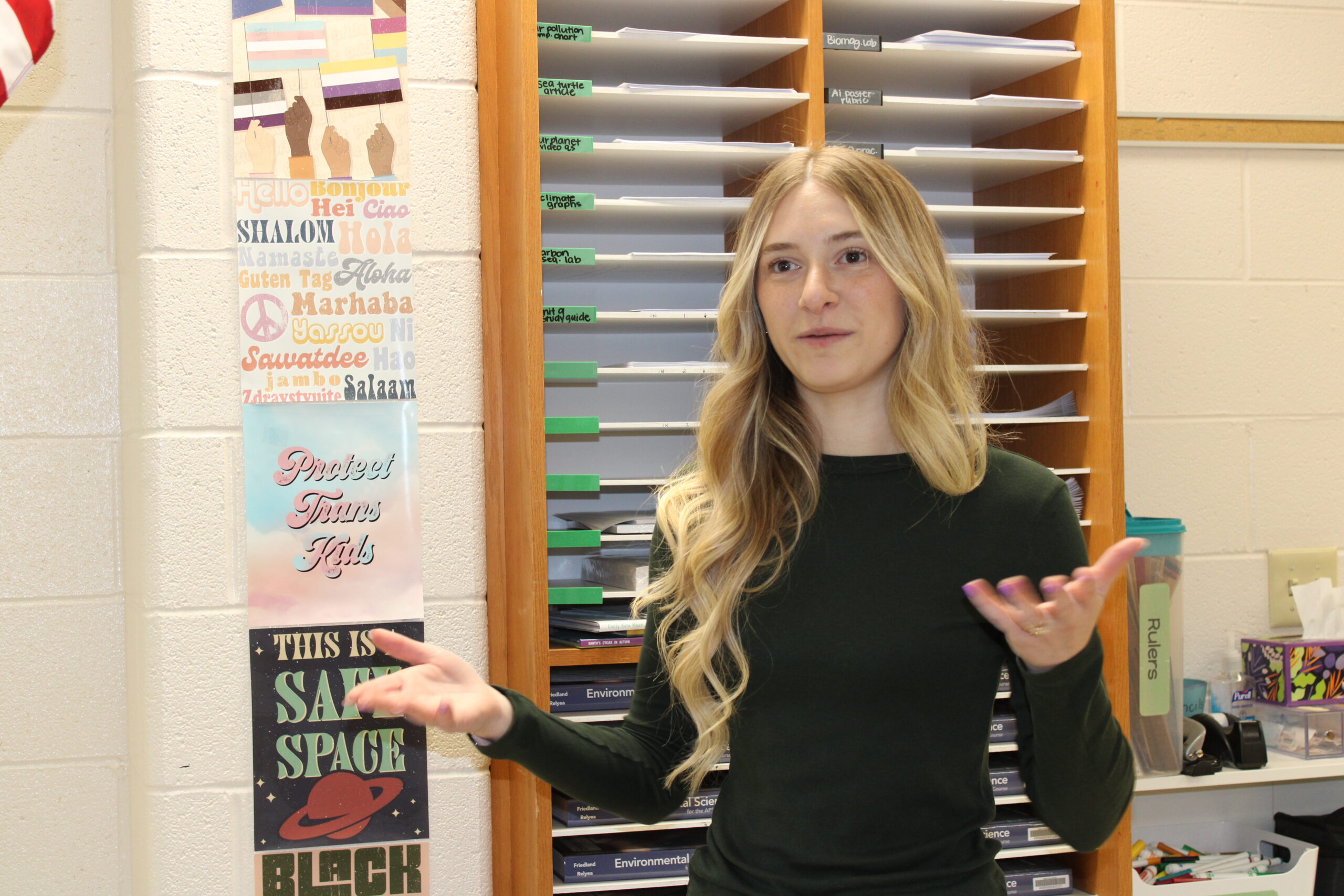
For Erin Janecko, a science teacher at MHS, the classroom is a safe space. Janecko said that, as a member and ally of the LGBTQ+ community, she intentionally fosters an inclusive space where students feel secure sharing their personal experiences and identities.
“School should be a welcoming place for everyone,” Janecko said. “All students deserve to feel safe at school.”
Under HB8, districts must also adopt policies that allow parents to review and opt out of instructional materials containing sexuality content, which impacted Advanced Placement Psychology at MHS during the 2025-2026 school year. Before learning about gender and sex, an email was sent to parents notifying them of the curriculum, and parents were given the option to opt their child out of the lesson. Reign Matu, a senior at MHS and president of the school’s Gender Sexuality Alliance (GSA), said individual preferences should not influence what academic material is taught.

Science teacher Erin Janecko speaks with a student as inclusion posters line her classroom walls. She said she uses decor to help students feel comfortable and safe.
“Being aware of something does zero harm to you,” Matu said. “Hate comes out of ignorance a lot of the time. Maybe people just don’t know what they’re saying and what it means, so educating when you can [is important]. Build yourself up as much as you can, so that other people can’t bring you down.”
Twenty minutes away from MHS, one classroom at Little Miami High School displayed a poster that said, “Hate Has No Home Here,” featuring illustrated hands holding the American flag alongside rainbow, transgender and peace flags. On February 25, 2026, the Little Miami Schools Board of Education voted to remove the poster due to implications with parental notification and opt-out requirements under House Bill 8. Janecko said as a teacher who values inclusivity, the decision from the Little Miami Schools Board of Education undermines efforts to build classrooms where students of all identities can learn without fear of exclusion.

Multiple posters in Erin Janecko’s classroom display the message “I pledge to advocate for
safe learning environments” and pride flags.
“I don’t understand how telling people that we should respect and love other people who are different from us is harmful to children in any way,” Janecko said. “Saying [that] we should respect everyone, we should love everyone, we should treat everyone equally–how could anyone think that’s a harmful thing?”
Crissman said the safety created in classrooms for LGBTQ+ students using welcoming and diverse decor is more important than the potential discomfort students may experience seeing a rainbow.
“When I walk into a classroom, I am in fight or flight mode,” Crissman said. “Most of the time, I’m seeing how the teacher acts, how they interact with me [and] if there’s anything that signals [that] this is a place where I will be able to learn in the most productive way. Seeing the tiny little Safe Space stickers, or seeing ‘Trans Kids Matter,’ on a wall, immediately I’m overcome with relief.”
The walls of Janecko’s classroom are adorned with posters reading ‘Protect Trans Kids’ and ‘This is a Safe Space,’ as well as a bulletin board with photos of Janecko with her fiancé and friends. Janecko said that, beyond wall decor, she speaks openly about her personal life to help students feel comfortable.
“I’ll show them pictures, or I’ll talk about how I got engaged,” Janecko said. “I think that helps students because they’re able to see what life [could] look like for them past high school, because I never had that.”

Wyatt Adkins is a senior at MHS who identifies as gay. He said that while legislation in Ohio and across the country is trending anti-LGBTQ+, it is not entirely representative of America’s stance on LGBTQ+ rights.
“There are two sides,” Adkins said. “There’s politically and socially, and I think that’s very evident today. Socially, being a part of the LGBTQ community has become more normal, and it’s not crazy that someone at our school is gay, lesbian or trans. But, politically, there’s definitely been a rise in hate.”
Matu said she also feels that legislation does not reflect what she has observed in her own interactions with others regarding the LGBTQ+ community.
“I definitely feel a disconnect between the general public, politicians and the media,” Matu said. “I think a lot of more conservative-leaning politicians are very outspoken about, ‘There’s no such thing as trans people,’ ‘Being gay is wrong,’ [but] I don’t think in daily life, I see as much of that.”
Ohio House Bill 68 (HB68) went into effect on August 6, 2024. The bill bans the use of hormone therapy and puberty blockers for transgender minors, and restricts transgender girls from participating in female sports at the high school and college levels. The bill was challenged in the Ohio Supreme Court on March 24, 2026.
Crissman is currently undergoing gender-affirming hormone therapy, which she has to drive three hours to Michigan to access. Under current state regulations, Crissman must wait until she is 18 years old to access hormone replacement treatment in Ohio. In Michigan, hormone replacement therapy is legal with parental consent, but major health systems have stopped providing the care for minors, and accessibility has decreased significantly.
“My life-saving care isn’t accessible in Ohio, so I go up to Michigan because Michigan does not have [a statewide gender-affirming hormone therapy ban] yet for minors,” Crissman said. “Gender affirming care is the reason I’m here right now, because people respected my identity and got me the help I needed.”

Members of the Mason High School Gender Sexuality Alliance (GSA), (left to right) Carly Chang, Mia Sullivan, Toby Fishback and Mackenzie Monds, meet on April 30, 2026 to discuss upcoming club elections.
With anti-transgender and anti-LGBTQ+ legislation being pushed in Ohio and across the country, Adkins worries that future legislation could negatively impact his life after growing up with LGBTQ+ rights.
“Now, you’re taking what I possibly want for my future away,” Adkins said. “We don’t know what’s going to happen to those [protective] laws. We don’t know if they’re going to be taken away or not. I just hope I’m able to live a life that I can look back on and feel thankful. If those rights are taken away from me, I won’t be able to do that.”
Citing concerns of LGBTQ+ rights continuing to be retracted, Adkins said that education and activism are more critical than ever to safeguard the rights of the queer community in an uncertain political climate.
“To use activism to support the LGBTQ community helps every person know that they have a voice and that they are valid in what they are thinking and feeling,” Adkins said. “It tells everyone that we are here and that we’re not going away.”