
Ruhi Kaneria | The Chronicle
This past weekend, May 1-3rd, thousands of runners laced up their sneakers and ran in Cincinnati’s Flying Pig Marathon Weekend in races from the 5k to the full 26.2-mile marathon. Among those runners were students and staff from Mason High School (MHS), each of whom brought their own motivation and goals to the finish line.
For MHS senior, Tessa Palmer, running has always been part of her routine. As a varsity cross-country athlete since eighth grade, Palmer has spent years building endurance and toughness in the sport. This year, she decided to take on a new challenge, with inspiration from her mom, who has been a consistent Flying Pig runner over the years. Like Palmer, her mother also ran both cross country and track in high school and now runs marathons with her friends.
Taking a small break after cross country season, Palmer began training for the half-marathon in January, giving her four months to prepare. While the transition from cross country to half-marathon training did come naturally to Palmer, she noticed both similarities and differences. The longer run styles with the eight to ten miles were familiar, but marathon training lacks the speed training that she did in cross country. Palmer appreciated the independence that came with creating her own running schedule, while she was initially worried about balancing her school work with hobbies and training.
“[It has been] easier than I expected, because I can pick and choose when I want to run like if I’ll run in the morning before school, or if I want to run after school,” Palmer said.
Another part of training that made it easier for Palmer was the companionship she found along the way. She was joined by senior Brooke Henson, who was also preparing for the half-marathon. Together, the two worked together to build up their mileage with shared long runs.
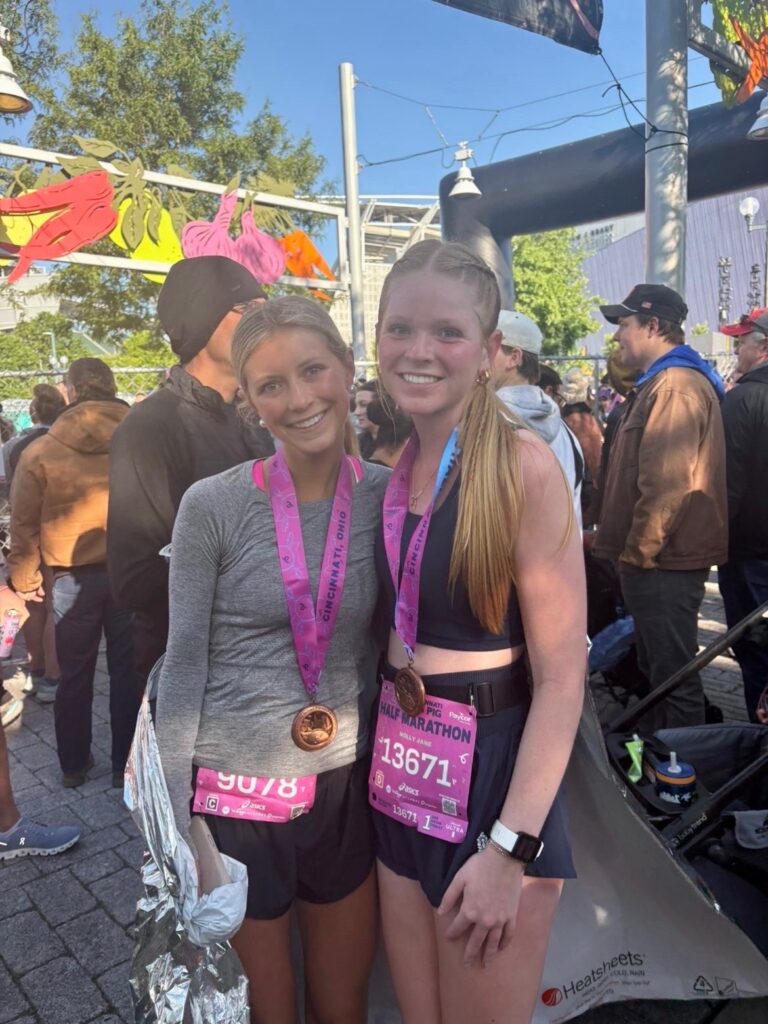
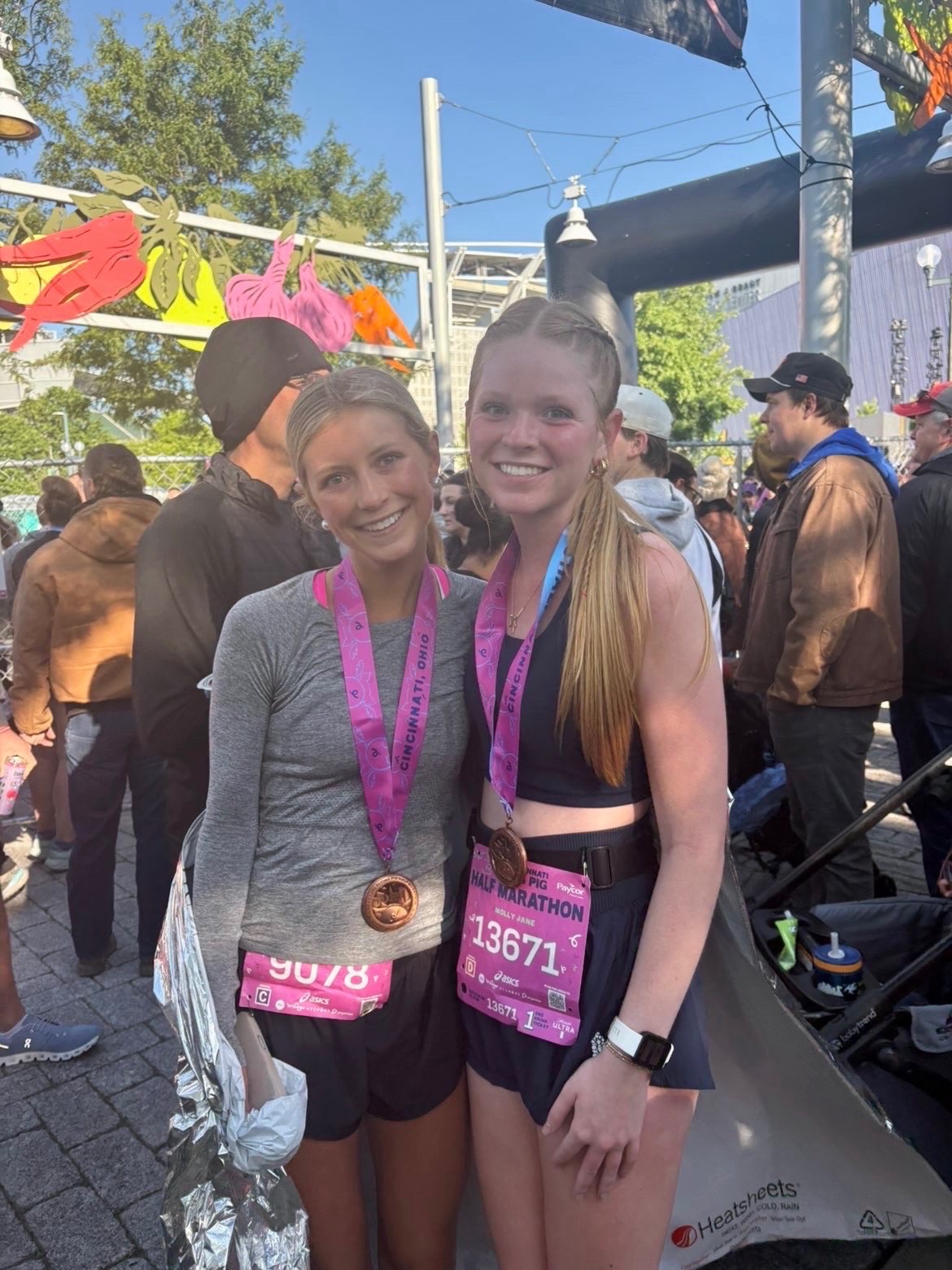
Senior Tessa Palmer (left) poses at the Flying Pig Half Marathon finish line with her former cross country teammate and MHS alum Molly McKay (right) after completing 13.1 miles.
For Henson, this half-marathon was a balancing act between training and her varsity softball performance. With practices every weekday to games several times a week, Henson’s schedule was packed with softball commitments and race preparation.
Before softball season started, Henson ran every day in the fall and winter. After her season started, she tried to squeeze mileage in between her softball training sessions, with longer runs scheduled for the weekend.
“[The hardest part of training] is managing my time with softball practice and games, and also trying to train for a half-marathon, because it’s a whole separate sport,” Henson said.
Instead of following a strict mileage plan, Henson adapted her run times to whenever she was available. By working around her school schedule, whether that is running during her free first bell or getting out early for C lunch, Henson was able to build up her mileage.
It’s not really, ‘Oh, I’m gonna run five miles today. It’s [more], ‘Oh, I have 45 minutes before practice so let’s see how many miles I can get in, or sometimes I’ll run before school because I don’t have a first bell, or on days like Thursdays, when I have C lunch,” Henson said. “It all just depends on the week, because softball can be rained out and everything gets flipped, so I just have to be flexible.”
Henson noticed that her softball performance had improved since taking up running. Her mental strength has grown because, in running, she knows that she can stop but forces herself to keep going. Henson has used her running to push herself to the best on the softball field.
“I feel like I’ve gotten more athletic and [am] getting to the base faster, and making more plays [in the outfield] that I wouldn’t have gotten to a year ago,” Henson said. “I was one step away, but now I’m there.”
While Henson experienced the physical benefits of running, others running the half-marathon found strength in the emotional resilience running requires. For Nicky Bozic, returning to running after physical setbacks became an act of discipline
Bozic has been running cross country since eighth grade, but she started taking long-distance running more seriously during her freshman year of high school. Even after this years’ season ended, Bozic enjoyed running on her own, making it a part of her daily exercise routine.
That consistency was tested earlier this year. After having her appendix removed, Bozic faced a long recovery that temporarily delayed her training. Instead of being discouraged, Bozic stayed committed to her goal of running the half-marathon.
“[The start of training] was supposed to be January, and then I got hit with surgery, so I got pushed a little bit and started preparing for it at the end of February,” Bozic said. “But I’ve always been running beforehand, so it wasn’t that big of a challenge to start picking it up.
For Bozic, she found the most challenging part of running to be staying motivated, especially if there is bad weather. To keep herself engaged, she often ran on the Loveland Bike Trail, where other runners, walkers, and bikers kept her focused and energized.
“The main goal [was] to have fun,” Bozic said. “I see myself running in the future, and if I keep having fun, I will keep doing half marathons and potentially even a full marathon or triathlon.”
For Bozic, her running stemmed from recovery. But for a staff member at MHS, a Thanksgiving Turkey Trot with his niece and nephews started them on a new path. For MHS football coach, Hope Squad advisor and social studies teacher, Brandon Sethi, running was not his routine. With the extent of his running career being 2 half marathons in 2014 and 2017, Sethi prefers to spend more time in the weight room.
Additionally, he and Alex Beurket, another teacher at MHS, participated in a reflection in January for the new year and selected a ‘misogi,’ a modern interpretation of a Japense ritual for yearly goal setting.
“It’s meant to be like a really difficult challenge that you have a 50/50 chance of being successful with, and so after running the 5k at Thanksgiving, I wanted to see if I could run a full marathon,” Sehti said. “At the time, I didn’t know that I’d be able to, because I was not a runner and spent all my time in the weight room, but it turned into just an opportunity to challenge myself in a unique, different way for me.”
As he committed to training, Sethi joined a run club in Cincinnati with around 80-90 members. Within four months, he noticed a lot of improvement, as he developed a consistent routine. Sethi made numerous sacrifices, from logging miles on Saturday mornings to over his spring break trip in Mexico. In the morning before his runs, he starts with a coffee, banana and an Uncrustable, what he has credit as a ‘lifeline’ through his training. He also uses the Strava app to be guided on a progressive build and wind down, and to schedule hills to prep for the full marathon’s 1,230 ft elevation gain.
Over his 16-week program, which included 4 runs per week, Sethi only missed one session. He credited this discipline to his run club, and noted that it has been the most rewarding part of his preparation.
“Being able to connect with new people, because as an adult, it’s really hard to meet new people,” Sethi said. “It’s been fun to be a part of a run club where everybody’s supportive, positive and there to help motivate.”
Beyond endurance, Sethi felt that the structure of the training had made him more productive, better manage stress and spend less time on his phone. He even applied his own coaching to his training.
“There have been many times that I’ve caught myself feeling sorry for myself, and then I remember what I put others through as a coach, and it’s like I can’t talk the talk and not walk the walk,” Sethi said. “Self talk and visualization [are] tools I’ve been using throughout of just being positive to myself, being okay with running my pace and not trying to compare myself to anybody else, but just making it about the drive of why I’m doing this and getting across the finish line.”
Although he doesn’t consider himself a natural runner, Sethi embraced the challenge. Even when he found himself at the back of his running club, he saw it as an opportunity for growth. For the race weekend, Sethi’s goal was simple.
“Finishing is the measure of success as an outcome,” Sethi said. “As coaches, we always say, you stick to the process, and then the outcome takes care of itself.”