
Grace Ai | The Chronicle
At Mason High School (MHS), teachers and students alike are identifying a subtle but consistent shift in comprehension and reading patterns. These local observations suggest that a diminishing grasp of more difficult material may eventually create obstacles for students when they transition into college level studies. The national decline in foundational literacy threatens to leave graduates unprepared for the heavier reading demands and the analytical expectations of higher education.
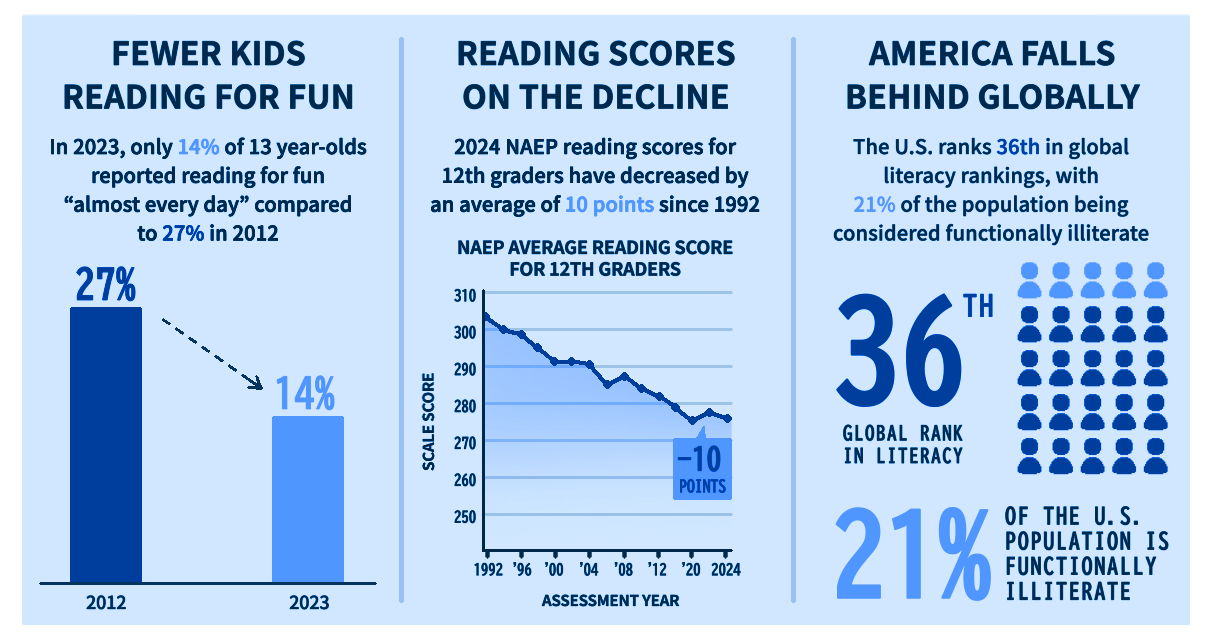
The topic of reading has been an area of interest for many researchers across the country as The Nation’s Report Card released the 2024 NAEP (National Assessment of Educational Progress) reading and math scores for twelfth graders, displaying the lowest reading scores since 1992. Since 2015, average scores have been decreasing and have fallen by an average of four points, suggesting a decline in literacy rates among high schoolers in the past ten years.
Additionally, studies conducted by the National Library of Medicine say there has been a decline in leisurely reading across the United States for the last twenty years. While MHS has typically performed above the state average for reading assessments, how has it been affected by the nationwide decline in reading?
MHS English and Creative Writing teacher Mrs. Bross mandates reading in all of her English classes, which she says stems from a want to encourage reading within her students. Alongside reading, setting goals is also a requirement in her classes.
“It’s my personal mission to turn my students into readers,” Bross said. “So independent reading is a huge part of my class. That’s an expectation shared across the ninth grade.”
While she hasn’t seen any drastic changes in reading habits, Bross says that there is noticeable decline, which often occurs around middle school, because that’s when many students start using phones.
“When kids get cell phones is when they stop reading, and it’s very difficult to compete with technology,” Bross said. “Even people who are really diligent, lifelong readers struggle. Sometimes I’ll be in the midst of a good book, then ‘oh, I want to check Facebook really quickly’, and you get sucked in.”
Sree Chandrasekaran, a sophomore at MHS, said that much of the enthusiasm that used to surround reading has diminished as her generation got older. Chandrasekaran said back in elementary school, reading was greatly emphasized, whereas now it’s easy for students to turn to ChatGPT or a different summary website to save time in their busy high school schedules, leading to what she describes as a literacy decline in favor of efficiency and convenience.
“Even in middle school, I’d come back after a long weekend and at least two people would be talking about a book they finished,” Chandrasekaran said. “[In high school], I never hear anyone say ‘I just read this amazing book,’ we barely talk about [reading] anymore.”
With the seeming deterioration of reading gaining more attention, PBS News says that the COVID-19 pandemic in 2020 might have impacted reading for those who were in quarantine and learning online, although the effects vary between age groups.
Bross said that while this might be the case for the newer generations, for some, typically adults, quarantine allowed them time to read more frequently, an opportunity to slow down and reacquaint themselves with old reading habits.
“COVID was so detrimental to current high schoolers because of the age that they were when it happened,” Bross said. “It was such an isolating thing, and while I do think some people found comfort in books, a lot of other people [turned] to technology.”
Because much of students’ screen time is spent on short-form content, some research studies have also shown a significant loss in attention spans. According to Bross, the issue of shortening attention is part of why many English teachers emphasize independent reading.
“Reading is important for stamina, it’s important to learn how to read hard things, and independent reading is the vehicle for that,” Bross said. “A lot of students don’t understand the volume of dense reading that they’re going to have to do when they get to college.”
For Bross, another part of why reading is so important is the ability to see new perspectives and practice empathy for others, as well as improving writing and communication skills. With modern technology like Artificial Intelligence (AI), it often becomes a means to skip these skill-building moments, leading to underdeveloped individuals.
“People don’t listen to each other anymore,” Bross said. “They are losing their ability to talk face to face with others.”
Freshman Rhea Bangera said that she really started getting into reading when she was 12, because of her free time. In 2023, Bangera set her personal record by finishing 55 books. Now, she says that her reading has steadily decreased since then as her life got busier and technology grew in importance among her and her peers.
“Looking at how much time people spend in front of their phones, if they have enough time to spend seven hours a day on their screens, then they would have the time to read,” Bangera said. “[But] they’re choosing not to.”
Bangera said a solution to this would be to make e-books (electronic books) more accessible, as libraries don’t promote them as much compared to physical books, and platforms like Hoopla and Libby go unmentioned among the general population.
“A lot of people say that reading is not for them,” Bangera said. “But it really depends on the book. I used to think like that, but then I found the right novels, and it totally changed for me.”
Bross says that adaptation is key, especially in a world with ever changing technologies. She said that even before our current digital era, she was hesitant towards using a Kindle to read, whereas now she’s integrated its use into her reading life and accepted the advantages and disadvantages of it. Bross said that while new tech can have its initial negative impact, there are always ways people can adapt.
“Reading is gonna change, and that’s always going to be the case, but it’s never going to become obsolete. People who are passionate about it need to share that passion with others,” Bross said. “Which is where you get #BookTok or #Bookstagram. It’s putting reading back in the forefront of our minds, and we need to appreciate what social media is doing. In some ways, we’re experiencing a resurgence.”