
Michelle Zuo | The Chronicle
After the intricate spins and complex artistry of Alsya Liu’s performance at the 2026 Winter Olympics, it’s no secret that the popularity of skating is on the rise. While figure skating remains one of the most popular winter sports globally, few recognize its land counterpart; roller skating.
For Mason High School (MHS) junior Sreshta Cherukumoolinti, her artistic roller skating journey started in North Carolina at the age of seven and continued as she moved to Ohio in 2018. After taking a gap year in 2020, Cherukumoolinti began competing for the Loveland Castle Skateland team. Cherukumoolinti continues to compete at the B level of artistic roller skating for her age group and trains roughly 8 hours each week.
“The freedom aspect of [roller skating] makes it feel like I’m growing wings,” Cherukumoolinti said. “My first thought was that going fast was the best experience; moving with such ease is so appealing to me.”
Cherukumoolinti said that beyond the variety in equipment and maintenance between the two sports, figure skating and artistic roller skating also differ in programs and events on competitive levels.
“We have this one special program called figures and loops, which has little circles on the floor and you trace them with your skates in different patterns,” Cherukumoolinti said. “Loops use different parts of your skates, and they’re more fun since they’re like spinning.”
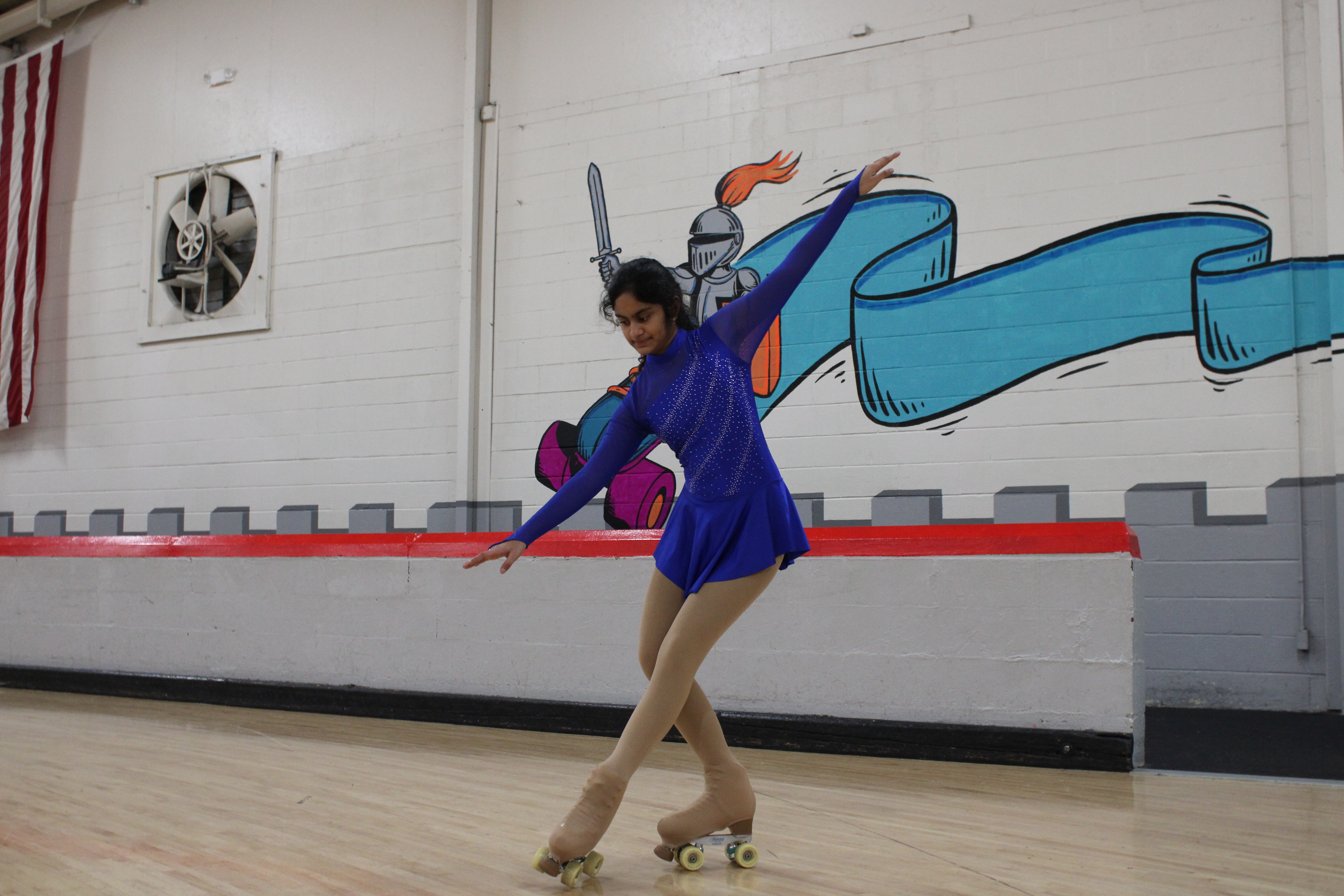
Cherukumoolinti performs a mix of classical ballet style pilie (plee-ay) with artistic roller skating
As Cherukumoolinti progressed, she began to expand her range of events through freeskating, show team, pairs, loops and figures. Cherukumoolinti said that while she enjoys trying these new skills, she’s faced a number of challenges with equipment and learning new events.
“You’re not allowed to have your toe stops [brakes] in loops and figures practice,” Cherukumoolinti said. “It was really hard for me to learn to trust my foot when there wasn’t a safety brake. For freeskating, I would get really self-conscious and think that everyone was watching me.”
Freeskating events consist of individual timed, choreographed routines with music. Cherukumoolinti said that although there are challenges with switching skating teams and facilities, growing up has been more impactful on her experience with freeskating.
“I’m more involved in the sport and take it more seriously because I’ve gotten older,” Cherukumoolinti said. “At the beginning, it was really stressful for me to be on the floor by myself, but as time went on, I got more comfortable and realized that even if everyone is watching, they won’t notice something that seems so big to me at the moment.”
Through the trajectory of her roller skating journey, Cherukumoolinti said that the biggest benefit of doing a unique sport is that it allows her to stand out and share a different skillset. Artistic roller skating also allows Cherukumoolinti to self-express through her routines, music choice, choreography and costumes. Cherukumoolinti said she usually collaborates with her coach on choreography, and one of her most memorable routines was to the song “Moon” by Cassidy Taylor.
“The whole meaning of the sound is that you’re growing away from someone who was your mentor,” Cherukumoolinti said. “This was applicable to my life at the time since a lot of my friends were seniors and were moving on, [so] I felt like I was losing a part of myself; my facial expressions were more reminiscing, not fully sad, just solemn.”
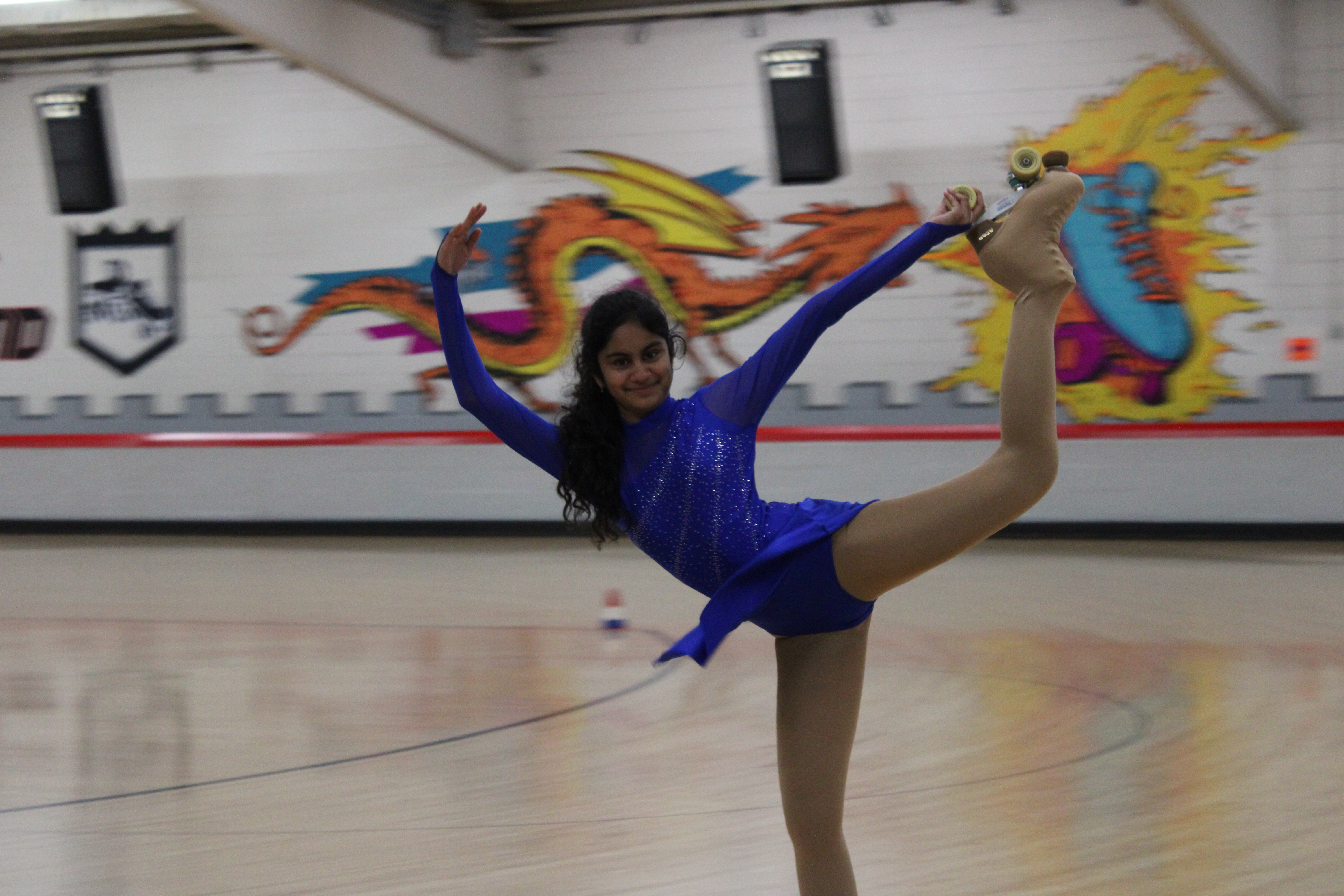
In addition to roller skating, Cherukumoolinti has been partaking in classical dance since 2020. Cherukumoolinti said that the discrepancies between the two are self-expression and how classical dance is performed as a group, while roller skating is a solo, mental act.
“You have to make the expressions really noticeable for both, but for dance, they’re a lot more nuanced. For skating, you just have to understand the overall mood of your song when you’re competing,” Cherukumoolinti said.
With the smaller community, there are usually only 2-3 competitors in each event in local competitions. However, in larger-scale regional events, there are around 10-15 competitors. Cherukumoolinti said that the jump from local to regional competitions can be daunting.
“I try to have as much fun as I can, but the more people there are, [the more] it stresses me out,” Cherukumoolinti said. “I’m usually just competing against my teammates and they really do push me to be better. Whenever I fall, I know they’re there to help me figure it out and it’s never been a super competitive environment for me.”
Cherukumoolinti said that overcoming the psychological challenges that arise within skating have helped her develop a positive attitude towards the practice of skating and the sport itself. Additionally, she said the mental aspects give her team the opportunity to become closer as they help and support one another.
“My mentality is to not put too much pressure on myself, while trying to find how much I can push myself at the same time” Chrukumoolinti said. “There’s a lot of stuff that I struggle with that I know a lot of other skaters also struggle with. Trying again with a different perspective usually helps.”
During the fall, Cherukumoolinti plays the flute for the MHS Marching Band while she teaches roller skating lessons after practices at Castle Skateland. Cherukumoolinti said that it can be hard to balance school, skating, marching band and classical dance, but she finds it helpful to apply the skills she learns from one to another.
“I’m able to understand from the kids’ perspectives and why they might be frustrated,” Cherukumoolinti said. “It’s very applicable since in marching band, people have come to me before and I’m able to give very specific feedback to them because I’ve taught skating to little kids.”
The recent rise in popularity of ice skating from the 2026 Winter Olympics has had an impact on the popularity of skating as a whole. Although roller skating has gained attention, Cherukoomlinti said that there are still aspects of it that aren’t understood.
“I wish people knew how difficult it is mentally,” Cherukumoolinti said. “Even in ice skating, you can’t judge based on how easy it looks because we’re supposed to make it look easy. But, I would hope that [artistic roller skating] gets more publicity in the future because it’s so similar to ice skating.”
Cherukoomlinti plans to continue artistic roller skating throughout high school and in college, aiming to be part of TeamUSA for the sport and possibly become a coach one day. Cherukoomlinti said that skating has taught her valuable lessons regarding grit and passion that she’ll continue to apply in her life.
“Passion is important because if you’re not passionate, it’ll be a hundred times harder to persevere,” Cherukoomlinti said “Don’t be afraid to give your all because you’re afraid of falling. If failure is the outcome, use that as fuel to keep working at it.”