
Michelle Zuo | The Chronicle
Whether it be writing poetry, creating bands or running marathons, Mason High School (MHS) teachers have long expressed themselves and their interests through hobbies. Although some of these pastimes have been picked up over the years, others have lasted since childhood.
For MHS World History teacher Rachel Pansing, that longtime passion is horseback riding. Pansing began official horseback riding lessons in her pre-teen years while living in Virginia. However, Pansing said that her love for horses began far before the start of her lessons.
“My mom said that I always loved horses and one of my first words was horse,” Pansing said. “The first horse that I ever rode was a mini horse named Buttercup. In the pictures I looked three to four [years old]. After that first little pony ride, I fell in love.”
Pansing’s great uncle owned a farm when she was growing up, and through this, Pansing shared her hobby of horseback riding with her mother and the rest of her family. Pansing said she continued to horseback ride throughout her years in college at Ohio University as part of the Intercollegiate Equestrian Association (IEA), riding twice a week and in competitions on the weekends. After graduating, Pansing said that she drifted out of riding as her life grew busier.
“I got married, I got a job and I started having kids, so I actually went around 15 years where I didn’t ride [horses],” Pansing said. “I sort of closed that chapter, but then I was recalled to it as part of my grief journey.”
In 2021, Pansing’s mother was diagnosed with terminal breast cancer. She passed away a year later. Pansing said that she came back to horseback riding during her mother’s cancer journey as a coping strategy for the grief she experienced.
“I had a lot of anticipatory grief where you know something’s going to happen, in this case, my mom’s pending death,” Pansing said. “I needed to find a coping strategy to deal with some of that in a healthy way.”
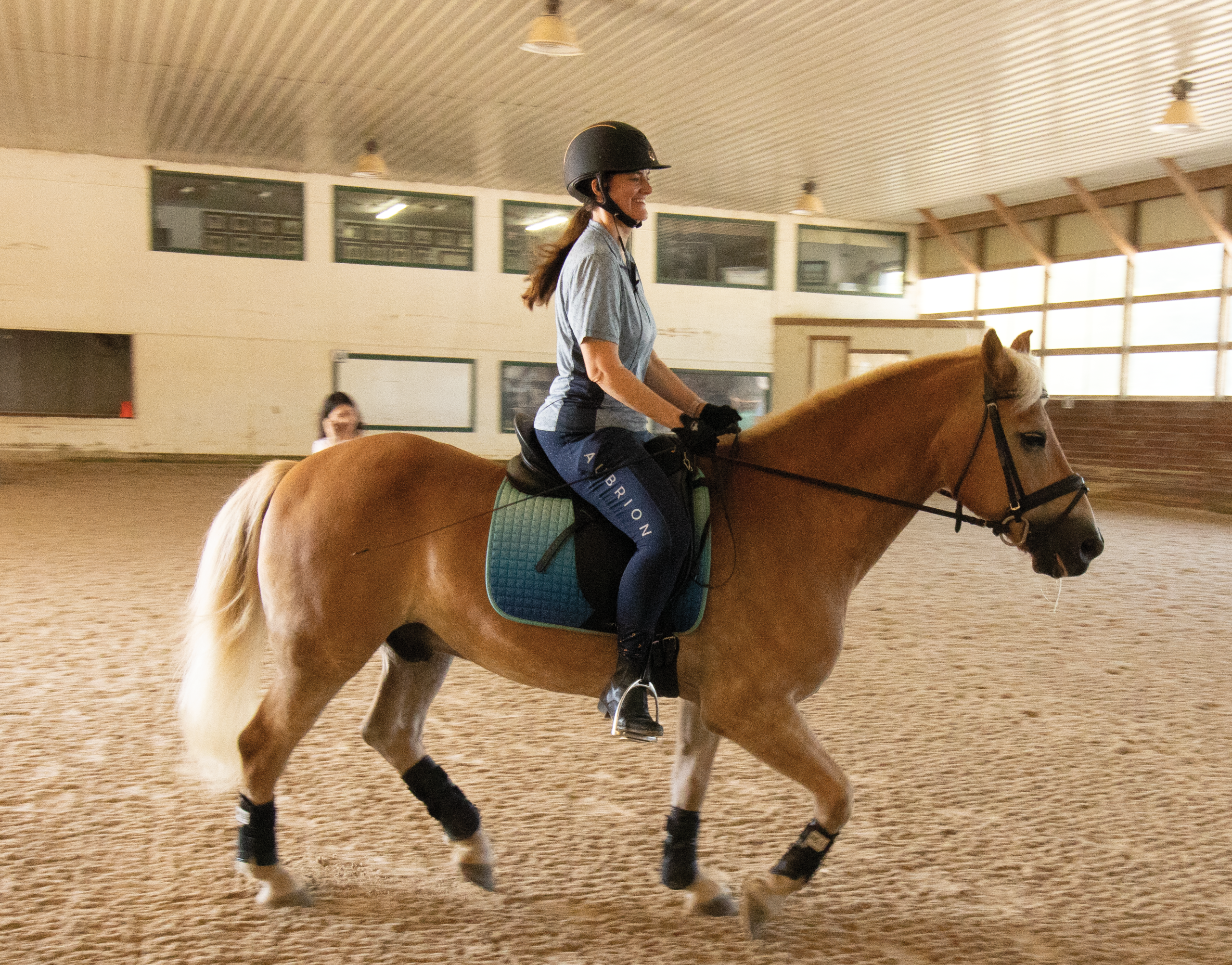
Rachel Pansing warms up her horse Nordic of Cedar Lane during a lesson at Hathaway Hill
equestrian facility.
After her mother’s diagnosis, Pansing found a trainer and horse through another MHS teacher to begin horseback riding again. In 2022, three months after her mother’s passing, Pansing met Nordic of Cedar Lane, a Haflinger horse. Pansing said that she originally planned on renting Nordic before the breeder decided to put him on sale for ownership.
“I think it was a little bit of love at first sight,” Pansing said. “But when I found out he was for sale, I [thought], ‘Oh no, I’ll never see him again.’ I talked to my husband about it, [and] we moved up the timetable because we felt that was the right horse for me. He was everything that I wanted; he was so peaceful and well trained. It was sort of a soulmate situation.”
Pansing said she learned of Nordic’s history through her trainer, who had been training with Nordic since birth as well as other horses in his family lineage, and who felt that his personality was the perfect fit. Pansing said that her connection with and eventual ownership of Nordic lead her to feel closer to her mother.
“I like to think that maybe my mom pulled some heavenly strings, got everything together and arranged for him to be mine,” Pansing said. “When I was little, my mom was always so supportive of any animal I wanted. The way I look at [getting Nordic] is [as] a final departing gift from my mom and that it was that one final dream animal, [since] that was the one animal that I couldn’t get as a kid.”
Although a love for animals is shared within her family, Pansing said that the reason why she began horseback riding again was not just because of that shared interest with her mother. Having seen the impact of horse therapy programs that support mental health healing for special-needs children, war veterans and grieving mothers, Pansing said that she became more interested in horses because of their mindfulness and attentiveness to humans and their environment. This played a role in Pansing’s decision to return to the hobby as a coping mechanism.
“[Horseback riding] forces you to be mindful when you’re riding or just next to an animal that [weighs over] one ton,” Pansing said. “You must be in the moment with the horse, for your safety [and] their safety.”
Horse size and power are not the only factors that force a rider to be mindful and present in the moment when interacting with them. Pansing also said that riders should take into consideration horses’ nature when it comes to safety.
“They’re herd animals so they mirror your energy,” Pansing said. “If you come in their presence and you’re acting very nervous, they’re going to pick up on that and start acting very nervous. But if you bring a calm presence with them, you’ll have that mindfulness.”
Despite having years of experience with horseback riding, Pansing said that she still faced challenges in the beginning when riding her new horse Nordic. Pansing said overcoming these obstacles allowed her to build a closer bond with him while also reconnecting with an old hobby.
“One of the first rides we had together was actually a bit rough,” Pansing said. “Even though I felt an instant connection with him, I was a little bit scared. Even if you feel a connection, you still have to practice together and build your partnership over a long period of time. The longer we ride together the better communication we have in our riding together.”
Pansing currently partakes in a form of horse riding called dressage, where the rider directs the horse in movements and choreography. Pansing said that the process of adjusting to a new horse and learning to communicate with him became the reason she began to feel more at peace in dealing with her grief.
“[Nordic] just brings so much peace and happiness to my life,” Pansing said. “I always feel so grateful when I’m riding, even if the lesson was harder. As a very little girl, I was always like ‘I want to have my own horse and to be an equestrian.’ So every time I go to see him, I always [think], ‘I can’t believe my dream came true, I can’t believe this is real.’”
Pansing has navigated her grief for years with horseback riding and her connection with Nordic aiding her along the way. However, Pansing said the feeling of loss never goes away, still impacting her at sometimes unexpected moments in her daily life.
“I’d be angry about cancer [and] angry that there was nothing I could do to help my mom,” Pansing said. “[But] sometimes I was sad about the same things. I feel like I went through all the stages of grief at different times. Grief is not linear, at any moment you might see something or hear something that makes you think of the person that you’re grieving, and it might instantly bring up an emotion that you weren’t expecting.”
Pansing said that her journey with grief has changed her as a person and as a teacher. Her experience has shifted how she views her job and other parts of her life, allowing her to become a more understanding person.
“I like to think that it’s made me more of an empathetic person,” Pansing said. “Students aren’t always going to tell [teachers] every personal detail because we’re focused on whatever that day’s lesson is. I always try to remember that everyone has a story and we all carry a lot. I want to use my own grief as a catalyst for others and to let them know that I’m here for [them] even if [they] ever want to talk about it.”
In discussions regarding grief and hardships, Pansing said that her main piece of advice is to realize that everybody handles grief in different ways at different paces. This is why she encourages others to discover and pursue those parts of themselves or places within their life that they can find comfort in.
“It’s okay to feel what you feel and it doesn’t have to look like anyone else’s grieving process,” Pansing said. “There is no right way to grieve. You should do what you need to take care of yourself, that’s the early grieving process. For some people that might look like getting back into horseback riding lessons after 15 years. [Grief] never goes away, but it gets better.”