
Henry Clipson | The Chronicle
Stress fractures. Torn ligaments. Repeated concussions. Serious injuries requiring long-term recoveries have become common for many high school athletes across sports and seasons.
The timeline for physical recovery is often clearly outlined for players, but the mental toll and bounce-back can be more variable. Every athlete experiences injuries differently, with recovery looking different from football players to wrestlers to basketball players.
The Mason High School (MHS) Varsity football team has reached the end of its season, and multiple players have sustained lasting injuries from playing and the physicality it entails. Senior Nolan Lapthorn is a safety on the Varsity football team. On August 17, the first week of the football season, Lapthorn tore his anterior cruciate ligament (ACL) and medial collateral ligament (MCL). This injury took him out of playing for the rest of the season. Lapthorn said that his experience discovering the reality of injury so early into the football season took a toll on how he initially viewed the season.
“I thought a lot of my goals were completely gone,” Lapthorn said. ”I thought my role on the team and role in school was [ultimately] diminished to zero, but I’ve had a great group of people around me. Friends, family and especially my teammates have been uplifting me [and] making me feel a part of the team.”
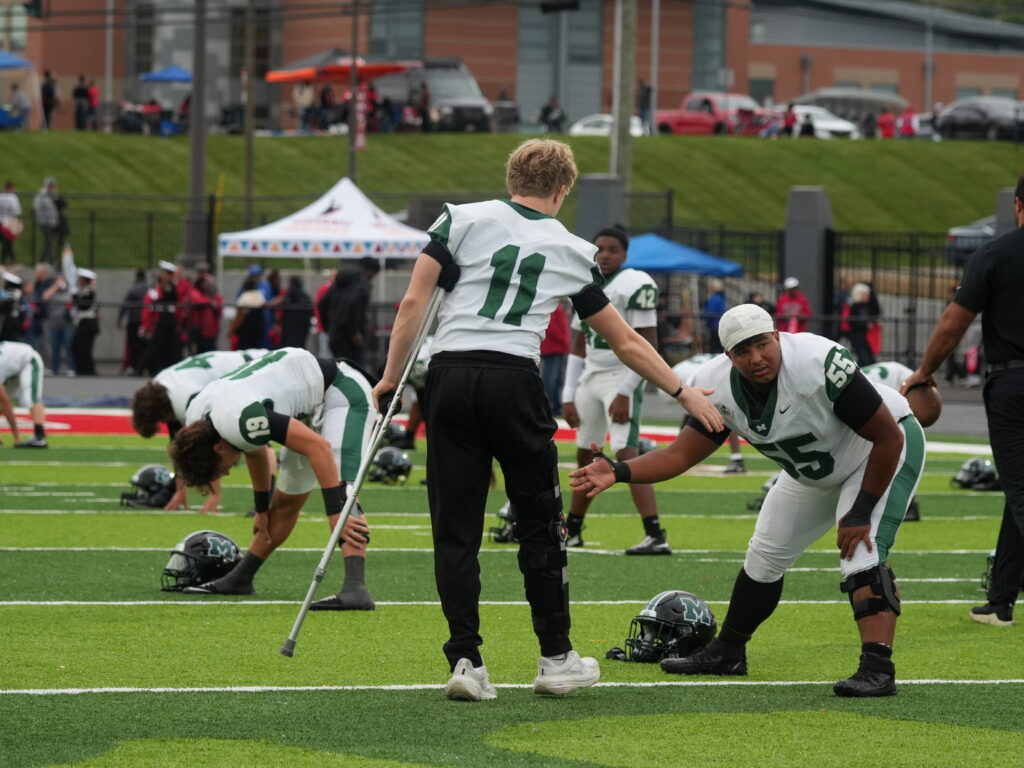
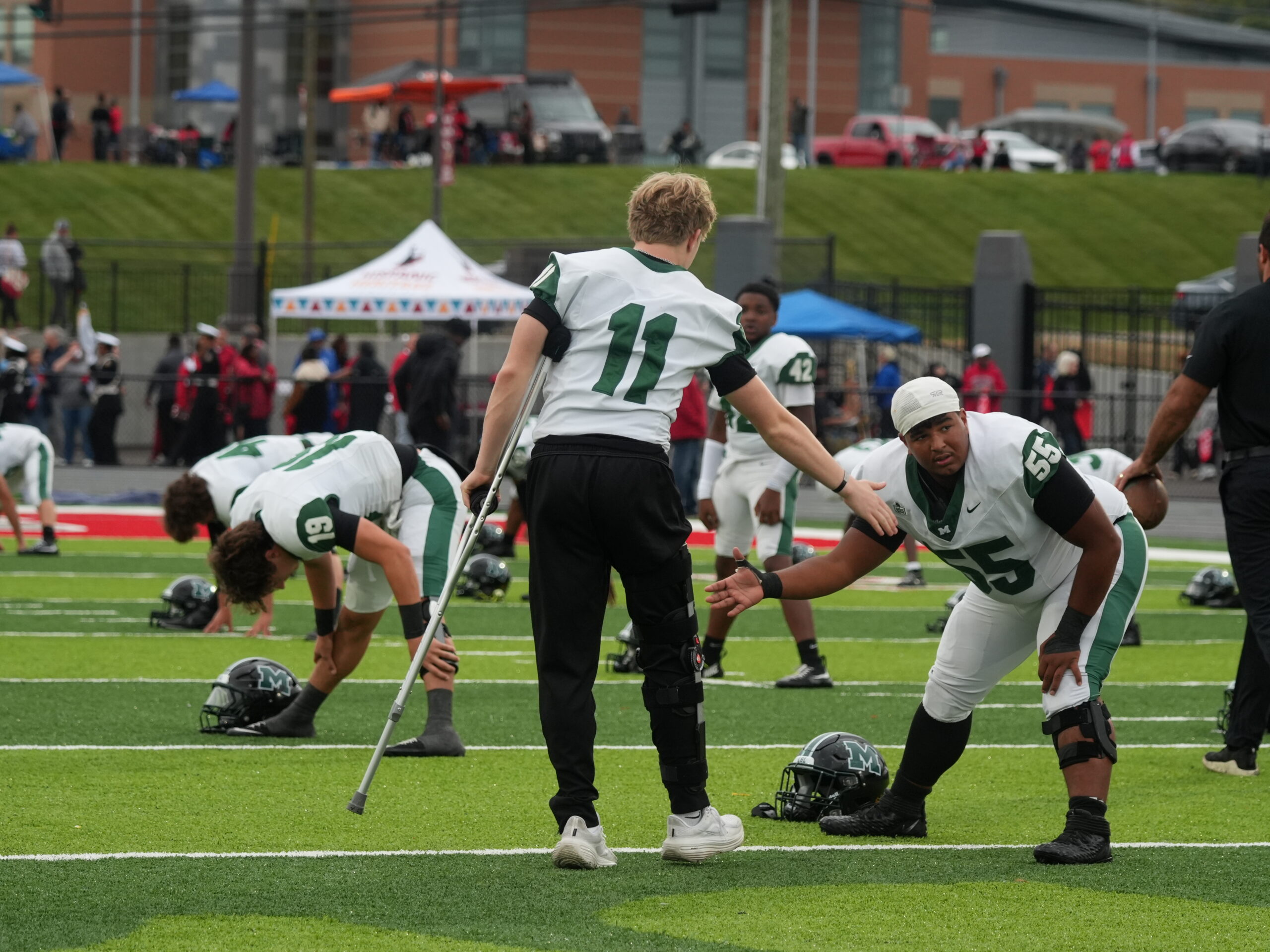
Mason Varsity football player Nolan Lapthorn (11) walks around on crutches giving his teammate Octavius Christopher encouragement.
Lapthorn said that although his injury was a major setback from being able to play football, consistency has been one of the most important aspects for him making a healthy recovery. Lapthorn said that recovering from a major ACL and MCL injury is no easy feat to conquer.
“[Recovery right now is] really small, extensive movements, [such as] moving my leg, getting my quad [muscles] back and working again and my hamstring working,” Lapthorn said. “I lost a lot of muscle in my right leg, and it’s just recovery [which] is very, very tedious right now.”
Recovering from an ACL and MCL injury requires six to eight months of physical therapy (PT) and rehabilitation. According to Dustin Groom, a professor in Ohio University’s School of Applied Health Sciences and Wellness, medical studies have reported that as many as an estimated 200,000 ACL injuries occur annually in the United States. Long-term injuries such as these have become increasingly common, especially among high school athletes.
Lapthorn said that his experience during surgery was not the same as another Mason football player with a similar injury, and that each person has a different experience with PT and rehabilitation.
Senior Octavius Christopher is a center offensive lineman for the Varsity football team and wrestler for the Varsity boys wrestling team. Christopher said that his recovery was not like many others that have a shorter recovery time of one to two months. He also said that his injury, consisting of an MCL tear in two places during his junior wrestling season, had a significant toll on his mental health, revealing to him the psychological side of injury recovery.
“It was hard not knowing if I’ll be able to be back for football,” Christopher said. “Seeing all of my boys win [matches] for wrestling was hard, [it was difficult] not being able to be out there and missing practices.”
Christopher said that watching teammates remain healthy and strong, practicing and competing in matches while he recovered from the bench, left him feeling let down and unmotivated to move forward. He said that although he faced setbacks physically and mentally due to his long-term injury recovery, he kept his eyes on what motivated him. He said he had many mentors during this time that helped him to a healthy recovery.
“Coach Mathews, Coach Castner and then of course my mom [ have all supported me],” Christopher said. “My mom was always there through every step, even though I was making her mad when I was [asking], ‘Can you get me this?’ Even though I just had surgery, and she was there, always.”
For many athletes, large motivators in their recovery process are crucial for well-being. Senior Grace Faulk is a forward on the Varsity girls basketball team. Faulk was injured during a rebounding drill before the regular basketball season started last year, and underwent intensive surgery on November 24, 2025, for her ACL and meniscus tears. As well as keeping her eyes set on larger goals, Faulk said that watching her teammates play while she is still recovering was a difficult experience for her mental well-being.
“For me, just not being able to play sports, doing [activities] that I love [was difficult], because I definitely am a person who wants to go do [activities],” Faulk said. “[My injury] made me sit around and watch [my teammates playing]. That’s probably the hardest part.”
Sustaining a serious injury during junior year can be especially impactful and daunting for athletes. They are left with one season to play high school sports, and potential recruitment for college athletics must be put on pause in the period when it would, in normal circumstances, be at its peak. Faulk was injured in November of 2025, which gave her plenty of time to rest, rehabilitate and build back her confidence before her senior basketball season begins.
“I have all of this time to recover,” Faulk said, “I have all of this time to get better. So my confidence should be built back up by how hard I worked in the off time.”
Because Faulk’s recovery lasted nine months, she said this long time period gave her peace of mind, knowing that she would have another chance at playing basketball. She said that the time recovering helped boost her morale, and she felt surrounded by the people she knew best.
“My family has a long history of ACL tears because we are continuously playing sports and being physical,” Faulk said. “The impact of all these ACL tears has made all of us mentally and physically tougher.”
Faulk said that having a support system who went through similar setbacks helped her remain positive with her recovery. She said it helped her stay informed of the dangers of tearing an ACL, and supported her goal of being injury-free.
Another mental factor within injury recovery is potential pressure for athletes to recover and return quickly, coming from coaches, family members and friends. Mason Athletic Trainer McKenna Connick said that athletes have all different types of pressure to come back and often do not know what to feel or what path to follow as they recover.
“I would say it’s important for student athletes to know what they want,” Connick said. “Maybe you play multiple sports, and you want to do just one. Maybe you do not know what you want. I think it’s important to figure out what your goals are.”
For Lapthorn, looking back now after experiencing the mental and physical journey of a long-term injury, he said that he encourages people to remain steadfast and optimistic if they face the adversity of a serious injury. Lapthorn said he can address what his future will look like by taking the small steps to be fully recovered and having a growth mindset.
“I would say it’s very easy to be mad at what happened and be mad at the world for what happened,” Lapthorn said. “But if you just take it day by day and step by step, you’ll look back and see how much time has passed and how much you’ve grown.”