
Maria Ataya | The Chronicle
During sixth bell, standard coursework gets swapped for stock portfolios. At Mason High School (MHS), investing is not something students read about in a textbook; it is something they experience firsthand. Through the Comet Capital Fund (CCF), 17 juniors and seniors who completed the Banking and Investments course manage a $25,000 portfolio, pitching investment ideas to industry professionals and making decisions that mirror a professional investment firm.
The concept for CCF emerged when program director Joe Schroeder observed college students managing a multimillion-dollar endowment portfolio at Xavier University. Seeing the potential in high school students, Schroeder said he pitched the idea to district leadership and secured $25,000 from the Mason Schools Foundation.
Schroeder said CCF is structured like an internship. Students are evaluated on attendance, performance and their understanding of stock market analytical tools.
“It’s not a class where you’re guaranteed to be there [or] getting a grade. You’re getting internship credit on your transcript,” Schroeder said. “It’s like a job.”
Managing real money exposes students to industry pressure. Junior and CCF Technology Sector Analyst David Darcy said he finds the high-stakes environment exciting, increasing his focus.
“I think we would take [CCF] as seriously, even if we didn’t have it being real money,” Darcy said. “But knowing that it is real money, we do have steps in place to make sure that we don’t lose it.”
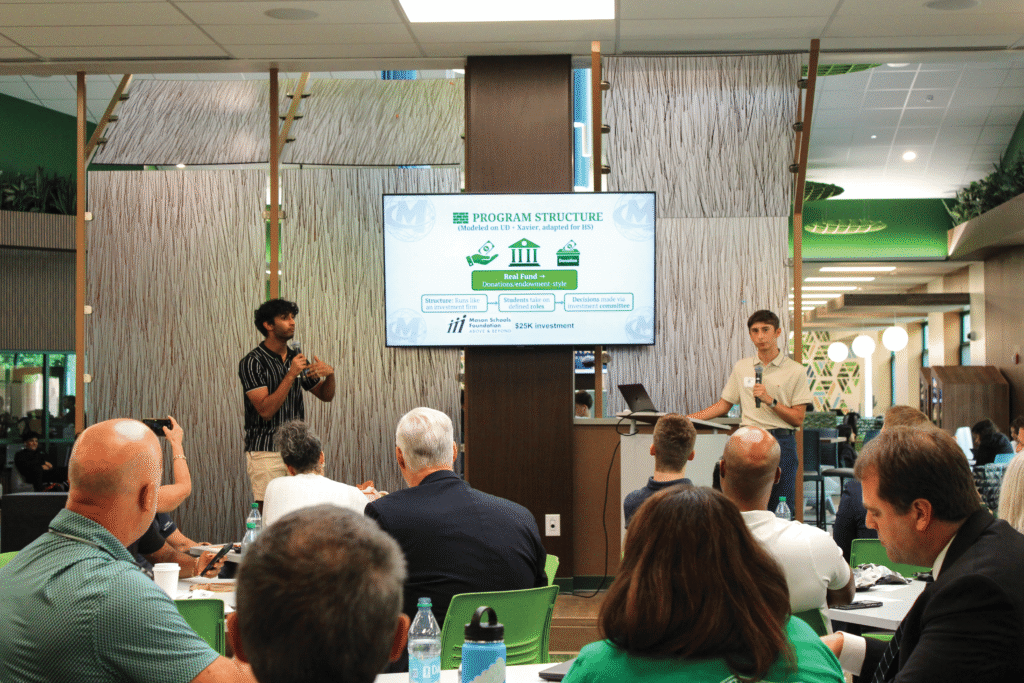
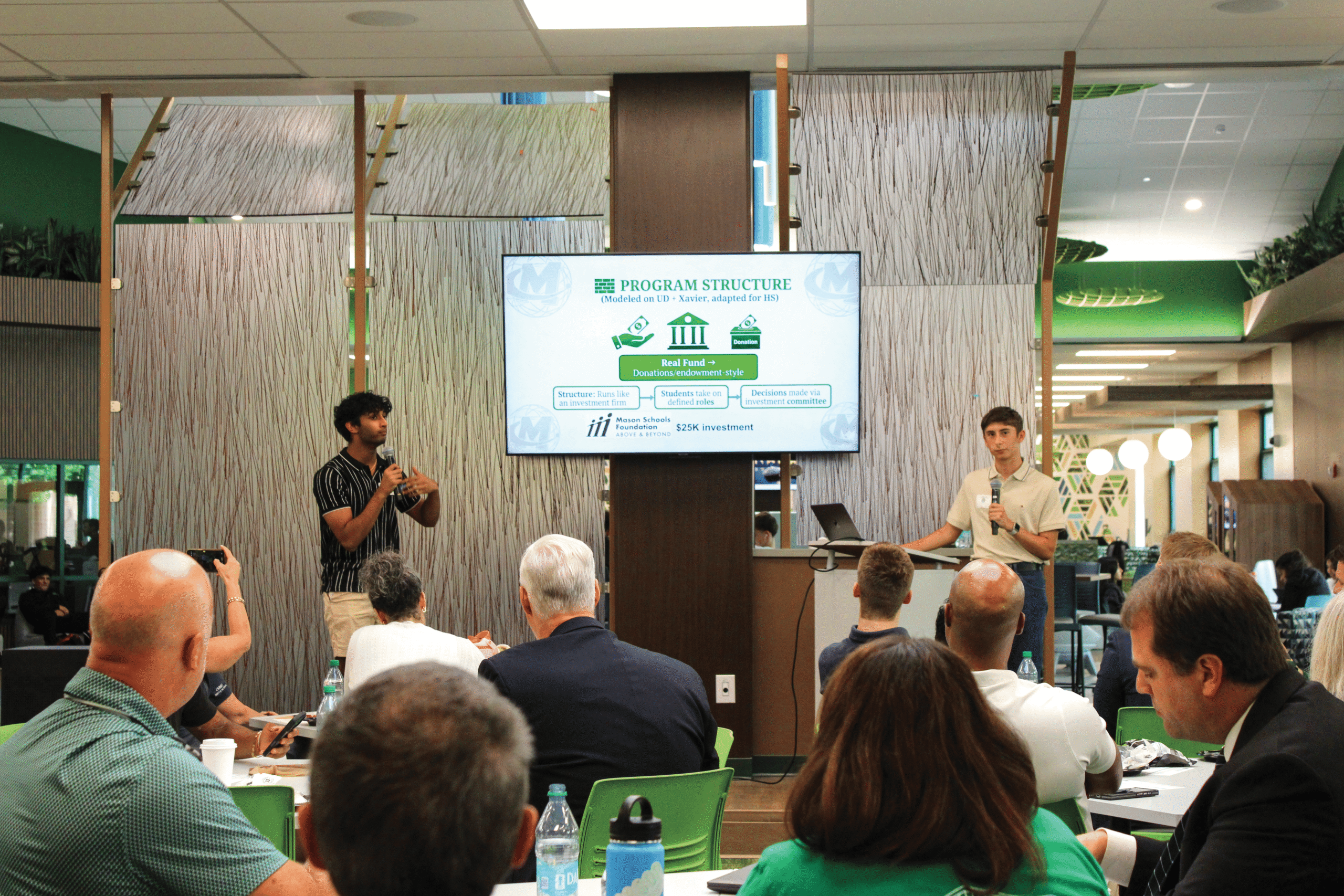
(Left to Right) CCF members Sri Bala and David Darcy present to Mason City Schools Superintendent Dr. Jonathan Cooper’s Business Advisory Committee about CCF’s future goals.
CCF aims to match or beat the S&P 500, an index tracking 500 of the largest publicly traded U.S. companies. But reaching that goal comes with the risk of losing money. Senior and CCF Chief Investment Officer Sri Bala said downturns are a natural part of investing, and the team has steps to determine what to do when a stock drops.
“If we missed something, we have to decide whether to cut our losses, sell, buy something else or hope it rebounds,” Bala said. “There’s going to be nerves, but as long as we make good investment choices, the goal is that it grows in the long run.”
Although the fund’s success is measured by numbers, Bala said its impact goes beyond the portfolio. The experience students gain can last beyond CCF.
“This program makes kids financially literate so that when they invest on their own, they can do so successfully,” Bala said. “If the fund loses money this year, I would hope people look at the fact that 17 high school students were able to learn so much about investing and finance, knowledge that a lot of adults don’t even have.”
Schroeder said CCF’s value is not dependent on money. He said the goal is to allow students to figure out what they might want to pursue after high school.
“[Helping students find their passion is] the number one thing. If [students] experience [CCF] and say, ‘Hey, I want to be a stock analyst,’ that’s what I’m hoping to see,” Schroeder said. “Or they say, ‘I did this whole experience, but you know what? It’s not the path for me,’ that’s all I want. Find your path.”
For Schroeder, exploration is most valuable when students take ownership of their work. He said that freedom sets CCF apart.
“When you use a fake portfolio, it’s like playing Monopoly,” Schroeder said. “That’s a fun game to play, but it’s not real money. It’s the real, authentic experience of ‘we have to make a stock decision’ [that makes a difference].”