Matluba Eshonkulova | The Chronicle
Mason High School (MHS) English 3 classes have begun turning childhood memories into museum-worthy artifacts through the Generation Z (Gen Z) Museum Project.
The project pushes students to define what represents Gen Z, from popular culture references to everyday experiences. After studying how different generations compare to one another, students are now curating exhibits that show what it means to grow up Gen Z. Their goal is to preserve the items, ideas and media that marked their experience and present them through a clear, meaningful lens.
English 3 teacher Tim Navaro said the project began as an effort to bring the junior classes together, focusing on their shared experiences.
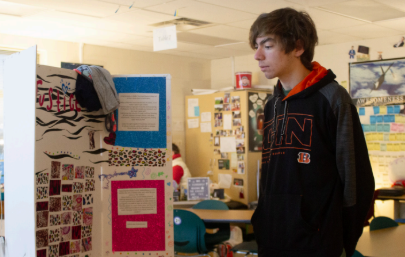
Junior Henry Malich takes inspiration from a past Gen Z museum project as he crafts his own.
“We wanted to get a unifying experience for the entire grade level, something to bring unity to a big school,” Navaro said. We came up with the idea for creating a museum-type experience, making it relevant by having it be all about Gen Z.”
Students have spent the semester breaking down how people communicate ideas through words, images, and symbols in class. Navaro said the museum format helps students see that symbolism is not just something found in books, but something they can build and present themselves.
“The strongest connection between the project and [English 3] is symbolism,” Navaro said. “We live in a world full of symbols, so we wanted them to create a symbolic representation of the tone or the feeling of their generation.”
As students explore what makes Gen Z unique, the project encourages them to consider how their worldviews were shaped by the media, technology and environments they grew up in. Navaro said this becomes clear when students compare themselves to other generations.
“They’re becoming more aware of how the culture is shaping them,” Navaro said. “They make the connection with other generations, asking themselves, ‘Why are they so different? Why do they have different values or attitudes?’”
In addition to analyzing culture, the project allows students to represent themselves through their own lens. Navaro said watching students design thoughtful, meaningful exhibits helps represent themselves beyond common negative stereotypes.
“I personally feel a little bad for Gen Z and how [they are] talked about in the media,” Navaro said. “Gen Z is always the focus point of the negative impact of technology, whereas it’s across the board. You look at your teachers, sometimes we’re scrolling on our phones, or we’re looking at Facebook. It’s influencing us too.”
MHS senior Adrianna Keck took English 3 last year and completed the project. She said her group chose to share how music connects Gen Z, and that they were surprised by how similar the generation’s tastes in music were.
“The project made me understand how connected our generation is,” Keck said. “Although we all live unique lives, we have so many things in common, and music is one of them.”
While previous years’ students reflect on the project in hindsight, this year’s English 3 students are just beginning to explore its possibilities. MHS junior Henry Malich is in Navaro’s class, working through the first steps of planning.
“I want to relate something to technology online into the real world,” Malich said. “I think that is a big part of Gen Z as a whole.”
With early exposure and access to the internet, Malich said his experiences with screens shaped how he sees himself and his generation, changing the way he communicated and learned.
“Being able to access basically the entire world at such a young age has a huge impact on the rest of your life,” Malich said. “The most misunderstood part about our generation is our laziness. It’s been pushed out there a lot. I’d say access to better things definitely influences that. [But] with the access to technology, things are becoming easier to research and understand. The complexity of what we research also goes up at the same time.”
Malich said the excitement of the project comes from the creative freedom since they will take something abstract, like a technological influence, and turn it into a physical symbol.
“The most exciting part about this project will definitely be [creating] something and bringing our ideas to life in a way we want to represent what we’ve been planning and working on,” Malich said. “It makes the whole thing feel real, like we’re actually building a piece of our generation instead of just talking about it.”