
Michelle Zuo | The Chronicle
From playing “Hot Cross Buns” on the recorder to performing in Carnegie Hall, students at Mason High School (MHS) have long used their musical talents to express themselves. While many pursue their passion through school music programs, some take their skills further by exploring unique instruments outside the classroom.
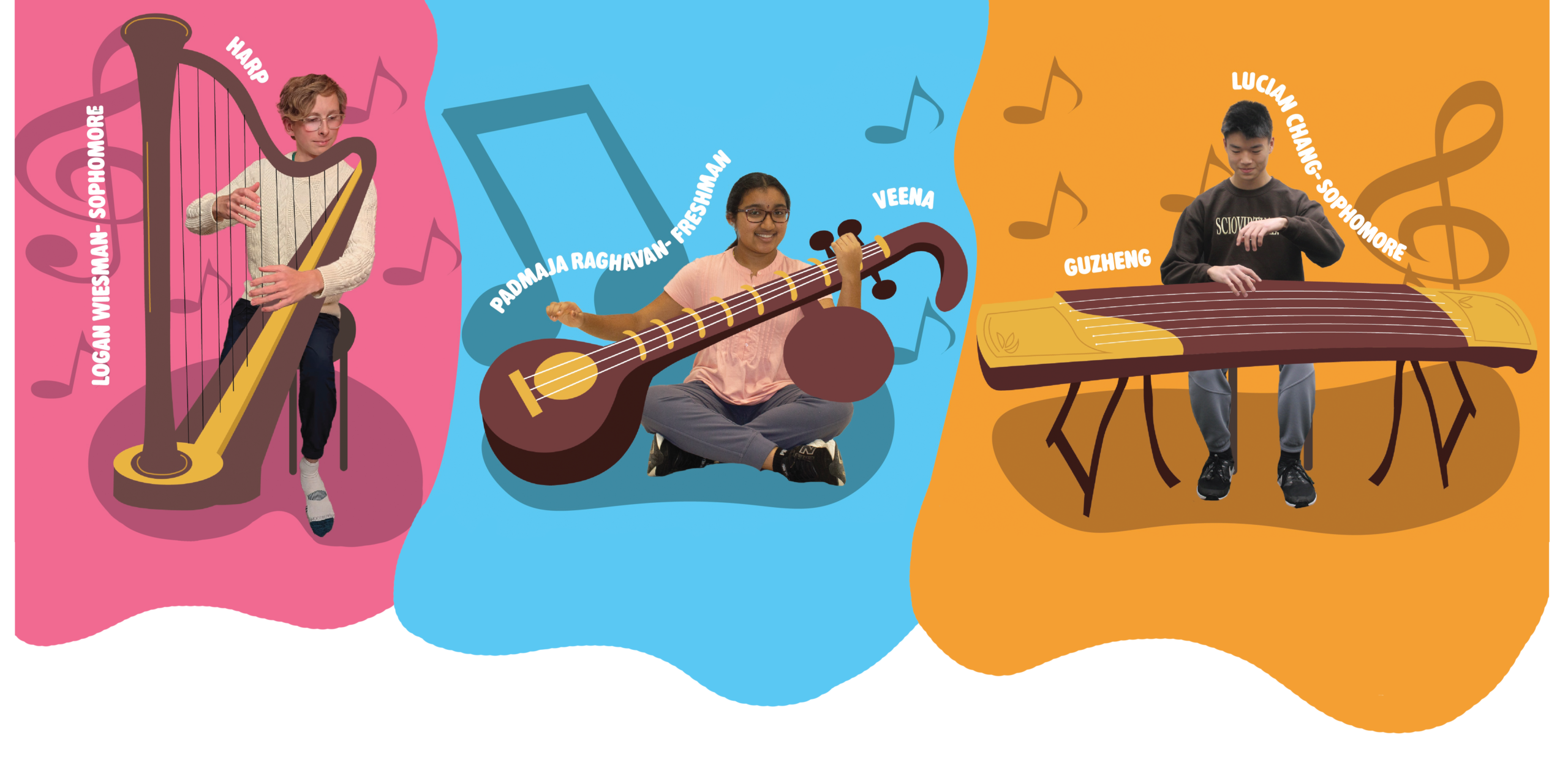
For some students, these musical passions go beyond mastering an instrument. It helps them to engage with their culture. MHS freshman Padmaja Raghavan plays the veena, an ancient Indian stringed instrument used for religious and spiritual parts of Hindu culture. Raghavan started learning the veena at age 6, later performing for programs like the Cincinnati Dayton Srutilaya Association as her skills advanced.
“[Peforming] has made me more proud of my culture and music,” Raghavan said. “It’s given me an increased respect and admiration for all kinds of artists because I now know how much effort, dedication and understanding [it takes].”
The veena is most commonly produced in one standard adult size. Raghavan said that many of the challenges she faced stem from how different the veena is from other instruments.
“As a kid, it was hard for me to reach all the notes because it’s a very long instrument,” Raghavan said. “It’s [hard to] bend the string to produce the kind of sound you want [since it takes] a lot of technique, control and practice.”
Despite the obstacles, Raghavan said that these challenges drive her to continue playing the veena.
“It takes a lot of practice and love for the instrument,” Raghavan said. “Each time I learn something new, [I find that] there’s always something more to be learned. It motivates you to go to that next level or perform better.”
Raghavan said that focusing on the background and history of the music allows her to represent her culture while connecting with her family’s history as she carries music down as a legacy.
“A lot of my grandparents played instruments [and are] musically connected,” Raghavan said. “My parents did not learn music, but the rest of my family did. My teacher has made a point to tell us the meaning of what we’re [playing] so we can convey the beauty [of it properly]. The [veena] is said to be the instrument of Goddess Sarawati, the goddess of knowledge, [which has] really helped me connect religiously by telling me the meaning of the composition.”
MHS sophomore Lucian Chang also shares his culture through music. Chang plays the guzheng, a traditional Chinese plucked string instrument. He said his family ties to the guzheng inspired him to begin playing it at age 9.
“My mom encouraged me because she played the guzheng in her college years for fun,” Chang said. “She learned it herself, and when she moved to the US, she had the original one shipped from China to here. So I kept seeing it in the house, and I thought it was really cool. I also heard Chinese music that always had guzheng in the background and was like ‘woah, what if I could do that?’”
Chang practices four days a week in one-hour intervals while taking in-person lessons for the guzheng. He said balancing extracurriculars and other instruments can be difficult, but through that balance, learning the guzheng makes it worthwhile.
“Playing the guzheng allows me to connect to my culture [since I’m] actively engaging in a key aspect of it,” Chang said. “Not only that, but being able to play the music that’s so often heard in many Chinese songs and pieces gives [me] a very surreal feeling.”
Aside from the guzheng, Chang plays the clarinet and piano. Chang said that the struggles he finds with the guzheng can be addressed using his experiences with other instruments.
“As I progress, the harder pieces become more technically demanding,” Chang said. “But the main [challenge] is playing with expressivity [or] displayed emotion that brings the song’s message [through] body movement. Playing other instruments helped me play with more passion, and the musicality you learn from each [instrument] helps feed into the other.”
Chang plays the guzheng for events such as the Fountain Square Festival. As Chang develops his musical passions both at home and in his community, MHS sophomore Logan Wiesman strives to do the same. Wiesman is a percussionist for the MHS Marching Band and has played the harp since age 7.
“I still struggle with a lot of things as a harp player,” Wiesman said. “But I’ve come a long way from where I started, and it’s because I focused on fixing one thing at a time. I was able to concentrate on my goals so I could slowly get better at playing, learning and performing.”
During marching band season, Wiesman continues to take classes and practice the harp outside of school. Wiesman said that his motivation to play the harp comes from finding new opportunities to perform.
“One thing that I like about it is that nobody really plays harp, so when someone needs a harp player, they come to me,” Wiesman said. “I think that’s so cool [and] it’s also just a really beautiful instrument [to perform].”
Wiesman has found different communities through performing the harp on stages from Ohio to New York with other musicians. He said that those connections inspire him to continue playing the instrument as he builds new relationships.
“[Carnegie Hall] was definitely the biggest stage I’ve ever performed on and it was a lot of fun,” Wiesman said. “In my third year of playing harp, my instructor got a group of young harpists together from all over Ohio. We did this harp ensemble with five [other] people, and it was just a good community. The harp community is so small and very tight-knit, [so] I’ve been able to meet and perform in small ensembles as well as different recitals.”
Wiesman began playing percussion at school in seventh grade. Pursuing both the harp and percussion has allowed him to improve and plan for the future of his musical passions.
“I’ve heard from my teacher that harpists typically struggle with rhythm,” Wiesman said. “But I’m a percussionist, and it’s based on rhythm. So I see no difference, and I think they work pretty well together. I want to keep [the harp] in my life for a long time. I don’t know what I want to do or if it’s just going to be performing, but I definitely want to keep it with me.”
Wiesman said that he encourages others to understand and appreciate the process of learning new things, such as unique instruments.
“Starting anything new can be challenging and not mastering it on the first try doesn’t mean you should give up,” Wiesman said. “Work on improving one thing at a time, and slowly, that challenging task will become easier.”