

Hailey DeGroff | The Chronicle
Over the past few decades, youth and high school sports have changed dramatically. What used to be a simple way for kids to play, explore and stay active has now become a carefully planned timeline.Parents, coaches and athletes feel the pressure to excel, hoping to secure opportunities such as college scholarships or even professional careers.
As kids grow older, that pressure often intensifies and specializing in one sport becomes the expectation. Parents hoping to give their children an advantage sometimes struggle to find balance between support and overinvolvement. For high school athletes, the line between encouragement and pressure is thin.
Freshman year is often seen as an exciting new chapter for student-athletes, but it can also be one of the most stressful. Michelle Brinkman, Mason High School (MHS) guidance counselor and freshman Sideline Cheerleading coach, said the jump from middle school to high school brings higher expectations, faster-paced environments and increased competition, both on and off the mat.
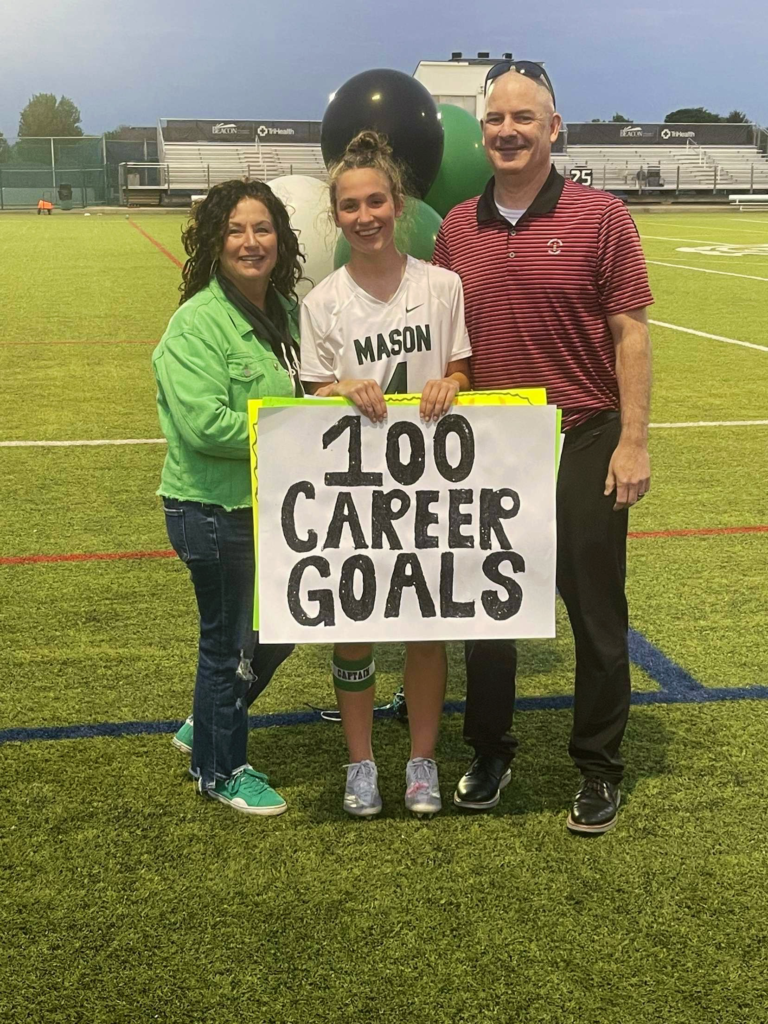
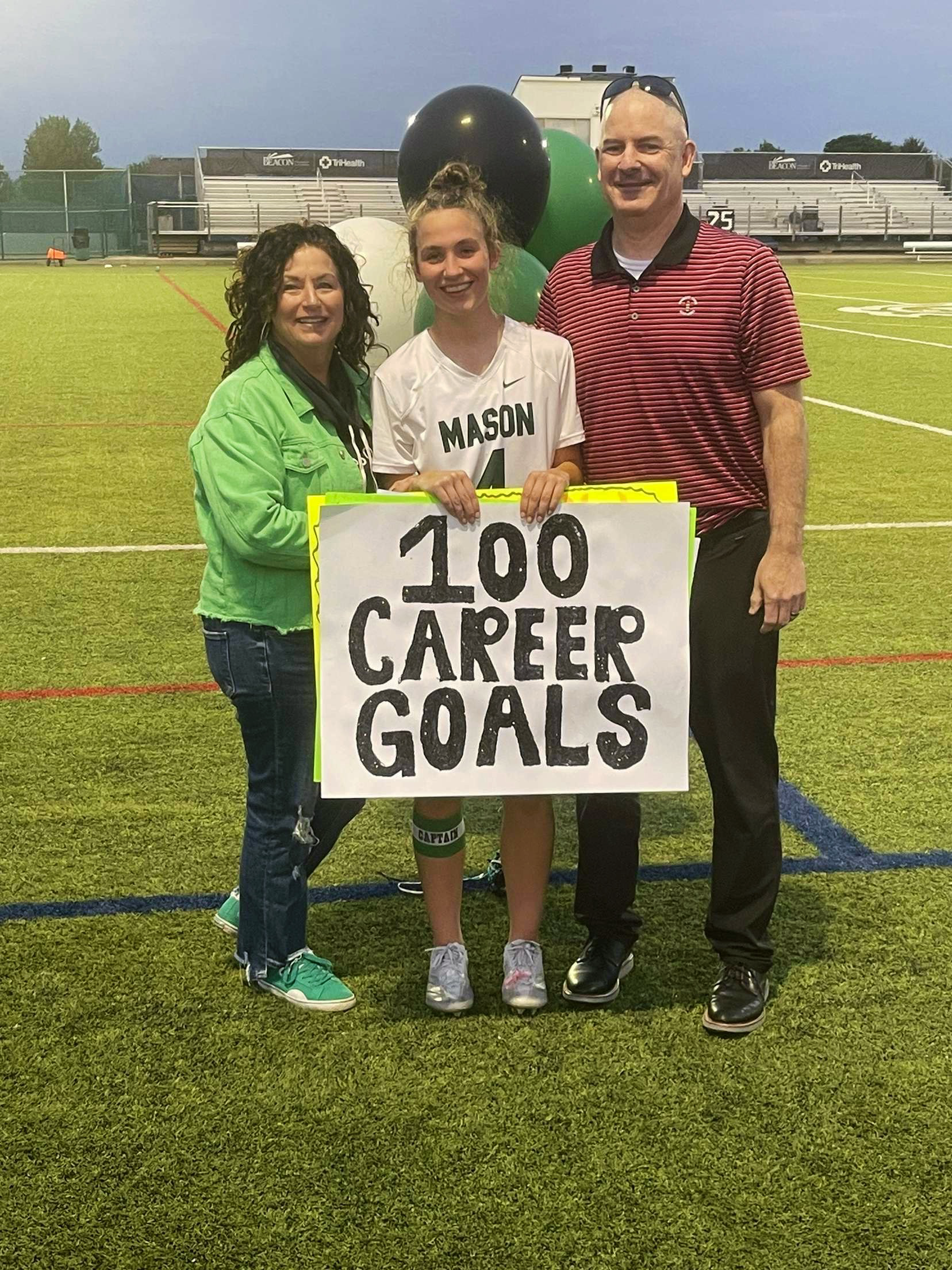
Senior Kirsten Hurr and her parents, Teryl Hurr (left) and Chris Hurr (right), celebrated her 100th career goal milestone after a game against Lakota West on May 6, 2025.
“Freshman year is a big transition from middle school to high school,” Brinkman said. “Parents are accustomed to managing their child’s schedules, transportation and communication with coaches and tend to stay closely involved as their child transitions to the high school level.”
While heavy involvement often comes from a place of care, it can create challenges for coaches who are trying to help athletes become independent. Brinkman explained that one of the main goals at the freshman level is teaching athletes to take responsibility for themselves.
“At times, communication comes from the parent to the coach instead of directly from the athlete,” Brinkman said. “Freshman year is especially focused on building that transition and gradually helping athletes take ownership of their schedules, responsibility and communication.”
In cheerleading, parental pressure can present itself differently than in other sports. Because cheer is judged on performance rather than wins and losses, expectations can be especially high. Brinkman said that the pressure of being constantly visible to parents and judges can have a real emotional impact on an athlete.
“When the focus becomes perfection or approval rather than growth and improvement, the confidence in an athlete can drop significantly,” Brinkman said.
Athletes often become aware of their parents’ reactions during games and competitions, and that awareness can increase stress and anxiety. This awareness can be subtle, such as noticing body language on the sidelines, or more direct through conversations after performances.
“Athletes tend to look for approval from their parents,” Brinkman said. “Positive body language, encouragement and calm support from parents can help the athlete feel safe and confident, rather than stressing out and underperforming.”
While parental involvement is often most noticeable during the transition into high school, some coaches believe it begins much earlier. Tony Affatato is an MHS guidance counselor, as well as the freshman Football coach and the head coach of varsity Track and Field. Affatato explained that when he was growing up, athletes typically played one sport per season, leaving time to explore different interests.
“There is no free play anymore,” Affatato said. “Their time is dictated by parents in all avenues as they move from one organized activity to another, instead of them navigating what they really love to do.”
According to USA Today, nearly one out of six parents believe their child will go professional. Sports have become increasingly competitive at younger ages, with families feeling the need to keep up.
“Parents are literally [competing] against each other,” Affatato said. “[They are] always wondering, ‘What is this kid doing to get ahead? I want my kid to be ahead.’”
Affatato said that chasing scholarships too early can be harmful. Instead of focusing on personal growth, enjoying their sport and having fun, athletes may feel forced to meet expectations that are not yet realistic. He said that over time, this can lead to frustration and burnout.
“You do not know what a freshman will look like as a senior,” Affatato said. “We are worried about kids deciding early, when in reality development happens over time.”
This pressure, he believes, impacts athletes’ motivation more than their confidence. According to John Hopkins Medicine, about 60 million children participate in organized youth sports in the United States, yet nearly 70% quit by age 13.
“Motivation comes from passion,” Affatato said. “If you do not love it anymore because you have been forced into it so much, you are going to fall out of love with it. It is not the winning and losing. It is the camaraderie, perseverance aand teamwork. That approach is what makes sports great.”
Affatato said that this shift requires trust, patience and a willingness to step back. While support remains important, he says that giving athletes space to make their own decisions can be more beneficial in the long run.
“Let them navigate their passion,” Affatato said. “You can help by connecting them, but they have to want to do it.”
While parents can help athletes feel confident and motivated, too much involvement can quickly turn into pressure. Senior Kirsten Hurr has been playing lacrosse for most of her life, and her parents have played a big role in her success. In the 2025 lacrosse season, she was named the Greater Miami Conference (GMC) Girls Lacrosse Player of the Year.
“I think parent involvement is crucial for an athlete, and it allows players to be confident and feel supported,” Hurr said. “[However], too much involvement can cause pressure and cause drama to the team as a whole.”
Hurr has seen firsthand how parent interference, especially around playing time, can negatively affect both individual athletes and team dynamics. She said that situations like these can quickly become widely known among teammates, creating unintended tension among them.
“Some things spread like wildfire,” Hurr said. “A parent talking to a coach instead of the player going to the coach is one of them. Once the team finds out, that player has a spotlight and almost a reputation for it. It is a very uncomfortable situation that can be [easily] avoided.”
Hurr also emphasized how parental pressure shows up mentally during games and practices. Instead of playing freely, athletes may begin to overthink their actions.
“Sometimes it feels like you are playing not to disappoint [your parents] instead of just playing your game,” Hurr said. “Sports, especially in high school, are supposed to be fun.”
Healthy parent involvement can make a major difference. Positive support creates an environment where athletes feel safe to grow and improve.
“[My parents’] encouragement, positivity and support, no matter the outcome, really helps me succeed,” Hurr said. “Just showing up to games, giving rides to practice, and being proud of me as a person, not just as a player, makes a huge difference.”
Hurr said that at their core, sports are meant to be bring joy and balance. When that purpose is lost, the experience can quickly become overwhelming. She believes that keeping that in mind can help both athletes and parents stay grounded.
“[My advice is to] play because you actually love the sport, not just to impress people or make your parents happy,” Hurr said. “Sports are supposed to be fun and a break from school and stress, not something that feels like another job.”


5 thoughts on “Coaches, athletes navigate pressure in high school sports”
Comments are closed.