Maria Ataya | The Chronicle
The rhythmic clicks and clacks of buttons, the whirs of the remote sticks, and the clanking of metal crashing together are sounds familiarly known by Mason High School (MHS) students part of BattleBots, a student-run club branched off of Skills USA, a national nonprofit for students who want to pursue more technical careers. BattleBots members work together to design and build robots, which are then brought to competitions to fight robots from other schools.
Though the club has roots in science and robotics, Battlebots is about more than building robots and rosters; it’s also about the importance of building community. Here, students learn skills that can’t be taught in a regular classroom, learning collaboration under pressure, creative problem-solving, and the confidence that comes from bringing ideas alive and turning them into a working product. These kinds of skills spark passion, open doors, and create success long after the battles are over.
Neal Pandhi, a Senior at MHS and the executive coordinator of the Battlebots club, said the growth that the club has seen in the past few years is exponential. He said that when the club started three years ago there were only three competing teams, compared to the 8 they see now- making MHS the biggest school at official competitions.
“We’re still in that growth phase,” Pandhi said, “We’re really starting to get the ball rolling, we have a lot of new teams that are coming up to participate.” Pandhi said.

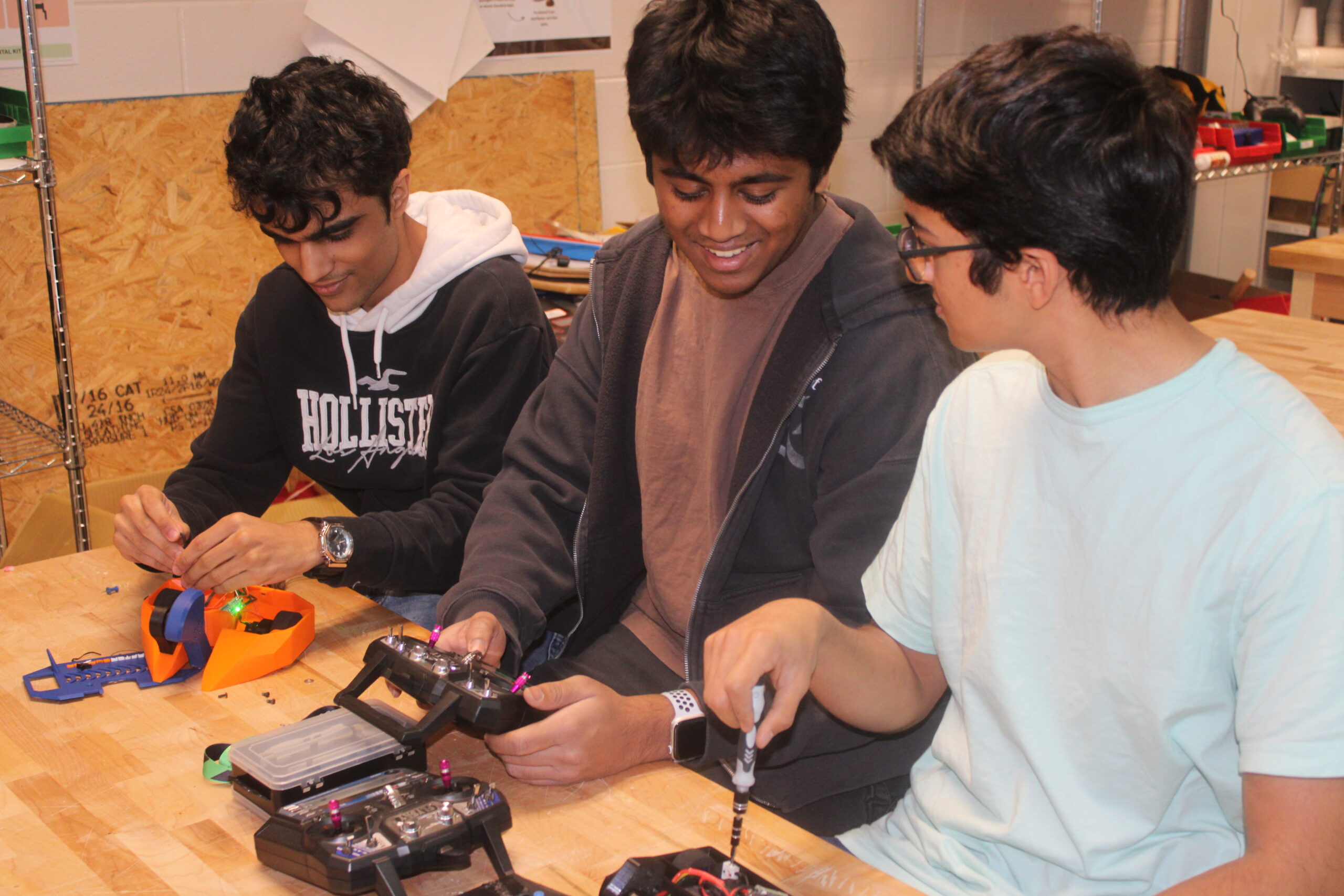
Neal Pandhi, Sarbesh Rajarajan and Imran Akbar prepare their team robot for comeptition.
Most of the competitions are held at neighboring Ohio schools, but occasionally they attend bigger scale events run by Skills USA. Pandhi said these competitions are very formal and judged based on things like arena performance, documentation of building the bots, and teamwork observation.
Pandhi said there are several character traits that make a good team member when it comes time to battle. When controlling a bot on the battlefield, it’s important to keep a level head and a clear mind, making sure you’re ready for whatever your opponent will throw at you.
“You also have to be passionate,” Pandhi said. “You have to be open to learning new things and be able to take feedback and criticism.”
Often when building a bot, students have to revisit and tweak small aspects of the robot over and over again, it’s not typical to build the perfect robot the first time. Phandi said he urges his other teammates to recognize that it takes mistakes, reconstruction, and overall failures to reach the success they’re expecting to reach.
Chris Pope, MHS teacher and the advisor of the club, said he takes different approaches with different students when it comes to coping with failure. Pope said his ultimate goal is guiding his students towards the standards they hold themselves to.
“I try to give [students] credit for trying something brand new, while also preparing them for the idea that robotics is not a one-time process,” Pope said. “They’re not going to have the most successful robot first try”
Pope said that failure is important for the members to experience, especially since many of the students in BattleBots are used to academic success; facing failure isn’t something they’re comfortable with. He said that in itself, how the students respond to failure is an important aspect of growth both in and outside of the club.
“Perseverance, creativity, and innovation,” Pope said. “A combination of those things is really what makes successful students in this kind of environment.”
Although failure might be difficult for students to face, they don’t have to face it alone. Battlebots places incredible emphasis on team-oriented and community-oriented clubs, which is what makes it stand out from other STEM clubs around MHS. Students give each other advice and guide them towards avoiding previous mistakes they might’ve made. Pandhi said the key to teamwork is to keep the social climate friendly.
“It is a very positive environment. People support each other,” Pandhi said. “It’s not like I’m going to withhold information from you because I’m competing against you. It’s, you know, hey, I’ll help you out because you’re struggling.”
Pandhi has goals and aspirations for the club that he may not be around to see, being a current senior set to graduate next spring. He said that he’s setting up the rest of his teammates for success in years to come.
“I hope the club will continue to have the sort of relationship that I’m trying to establish right now,” Pandhi said, “A healthy relationship with the battlebots community as a whole.”
As the club continues to grow, so do the students who shape it. With each new member, each robot built, and every piece of advice shared, the club grows in unity and purpose. The true power of the battlebots comes from the determination and persistence of the teams behind them, and with groundwork laid by Pandhi and other members, the club is destined to continue evolving, inspiring, and keeping those gears turning for years to come.
“My biggest piece of advice for the underclassmen is to be persistent,” Pandhi said. “They can’t expect to do well their first time, but they should expect to get better.”