Kaiya Lakes | Managing Editor | The Chronicle
In the 70s and early 80s, deafness and hearing loss were viewed primarily as a disability, a medical issue that required a medical solution. Over the years, deaf culture has changed and evolved into a community of people proud of their diagnosis and their language, American Sign Language (ASL.)
Mason High School (MHS) adopted its Sign Language program 23 years ago, brought here and designed by current ASL teacher Christie Loucks. ASL, taught as a foreign language at MHS, has become increasingly popular in the past 15 years, as society bridges the gap between hearing and non-hearing people.
Loucks said that to her, incorporating ASL into younger age curricula fosters a better-educated generation and allows her to continue to teach what she loves. She said that while the language itself is a significant aspect, the culture of non-hearing people centers around an identity with individual literature, humor, social norms, and history- and learning about that is just as important.
“It’s important for students to be learning ASL for several different reasons,” Loucks said. “Retaining the information that comes with learning a new language is much easier for younger people.”
According to the American Society for Deaf Children, only 10 percent of hearing parents learn ASL alongside their deaf children. Loucks said that while this statistic is startling, as she got older, she has understood the perceived difficulty of learning ASL while balancing a job, children and life.
“As an adult with kids of my own, I think about when I would ever have time to go and learn a new language,” Loucks said. “Parents of deaf children have to develop just as many language skills right alongside their child, often with half the time to dedicate.”
She fell in love with the language after teaching it to herself when she was just in fourth grade, leading to a lifelong interest in understanding, communicating and teaching the language to those around her. Loucks said that learning phrases and small bits of ASL is better than being oblivious to the language, especially since 85.58% of hard of hearing (HOH) children lack the necessary verbal skills needed to express themselves, according to the American Association of the Deaf.
“The language skills that utilize your mouth and your tongue are really fine motor skills,” Loucks said. “For a lot of toddlers, signing is easier and allows better communication between parents and children as well.”
Hearing-impaired people walk a fine line between the deaf and hearing communities, and MHS senior Julia Lorence is no stranger to this. At age 4, Lorence was diagnosed with Enlarged Vestibular Aqueducts (EVA,) an inner ear condition where a small canal in the skull is wider than it should be, affecting things like hearing. As a result, Lorence has taken note of the abnormalities and differences in her childhood compared to others around her.
“It’s awesome to get to see my cousins and young kids be able to speak and communicate,” Lorence said. “It’s so special to me that they can answer what their name is or what their favorite color is because that wasn’t something I was ever able to do.”
After Lorence’s diagnosis, she was fitted with hearing aids and was placed in intensive speech therapy, an attempt to catch up with the other children her age and their verbal abilities.
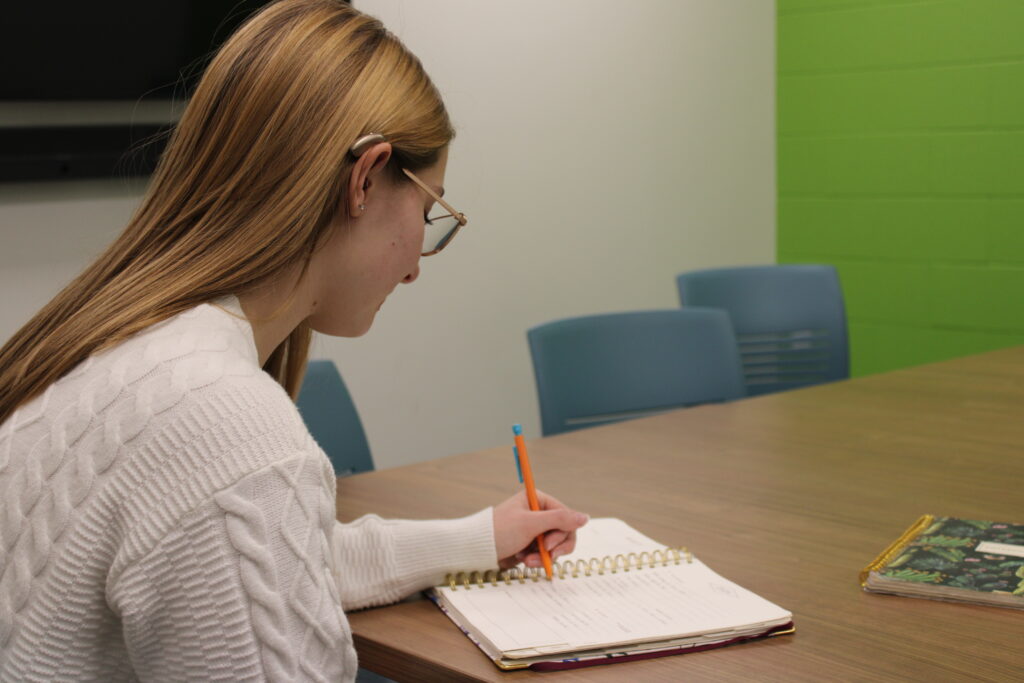
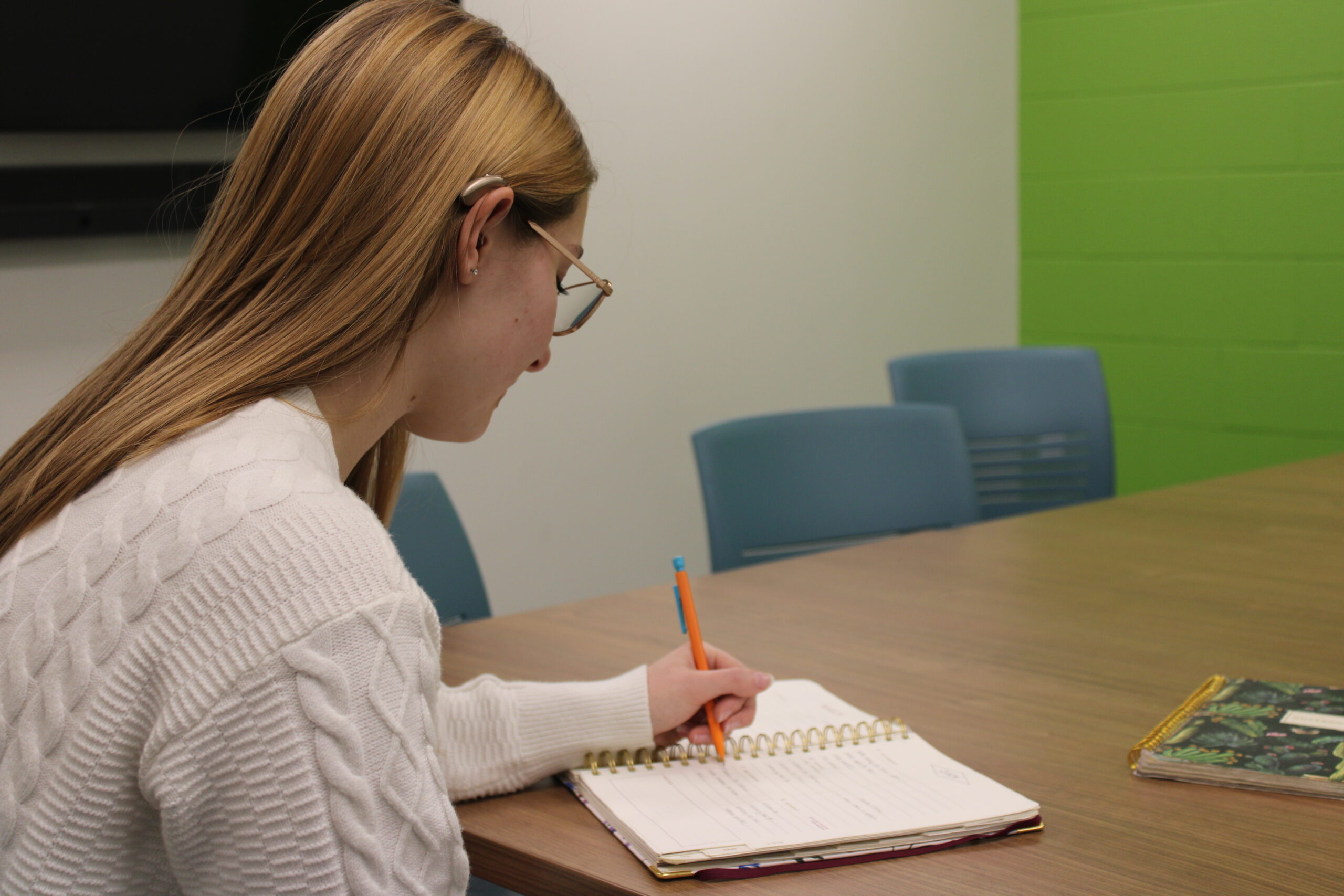
Julia Lorence actively participates in class note taking with the help of assistive hearing technology
“A lot of people think that hearing aids work just like glasses, but hearing aids cannot and will not ever be able to simulate real hearing,” Lorence said. “The hair on my cochlear nerve is dead, so the hearing aid transfers sound through a feedback channel at a frequency my brain registers.”
For Lorence, learning ASL later in her teenage years served as an outlet she hadn’t previously had. Lorence said that as someone whose brain has to work ten times harder to hear simple sounds, ASL is a refreshing lull of speaking and thinking.
“It’s hard for me to hear the nuances and complexities of spoken language,” Lorence said. “ASL is very theatrical; it relies on body language and movement instead of auditory cues.”
However, it’s not just spoken language that gets mixed up- everyday noises present their own set of challenges for Lorence and people like her. Small sounds in most people’s day-to-day lives can be difficult to identify or comprehend.
“If I hear a sound, unless I’m looking at you, I have no idea where it’s coming from,” Lorence said. “If one of the smoke detectors in my house beeps and someone else in my family can tell exactly what room it’s coming from, I’m shocked. I can’t identify the space, I can only hear the noise.”
Though Lorence didn’t grow up learning ASL, as a hearing-impaired person, she acknowledges its usefulness in bridging the communication gap. She urges her peers and others entering high school to use these resources and learn even simple phrases they might use in the future.
“Not only is the population of deaf and hard of hearing people already high, but I think we’re about to see a spike in sudden onset hearing loss because of things like AirPods and headphones,” Lorence said.“[Knowing ASL] will be more helpful than people think one day.”
MHS senior Claire Arnsparger shares the title of hearing impaired, though her adolescence was different from Lorence’s in some ways. Diagnosed at 8 months old with Auditory Neuropathy, she was fitted with a Cochlear Implant and placed in a program at Ohio Valley Voices, a school designed to teach deaf children with assistive devices how to speak and listen; barring the use of ASL.
“As someone with a Cochlear Implant, I don’t feel like I’m in the deaf culture of needing ASL, because of how I grew up, I think of it as a foreign language, like French,” Arnsparger said. “That being said, I think sign language can be helpful for younger generations, not just for those with hearing loss, but also for those who have speech delays or speech issues, or those who are nonverbal.”
Like Lorence, growing up immersed in spoken language, Arnsparger also has to consciously utilize more of her brain and focus harder to understand what’s happening around her.
“At times I worry about being annoying because I have to constantly ask people to repeat what they said,” Arnsparger said. “A lot of people think I’m shy or not friendly, but I really just have to put all my energy into listening; it’s a choice of whether I want to listen or speak.”
Being exposed to adaptive technology and the hearing culture so early on in her life, Arnsparger said she never knew she was any different- that’s just how she was born. Additionally, she has an older brother with the same condition, which gave her a greater illusion of a completely ordinary childhood.
“My parents never let me use my disability as a way to get things,” Arnsparger said. “In a world where everyone hears, I had to learn how to adapt, and it made me stronger. To me, there’s no difference, my disability has always been my normal.”
Contrary to Arnsparger’s experiences, Brian Thomas, a physics teacher at MHS, found his “normal” shattered after discovering his own chronic hearing loss just a few years ago. Thomas struggles with Tinnitus, a constant ringing in the ears, and now uses hearing aids in his day-to-day life.
“I first noticed my hearing decline while teaching,” Thomas said. “At first I thought that the students were getting quieter, maybe because of COVID, but then I started seeing it in my home life.”
Since Thomas’ hearing loss occurred when he was 54, his exposure to ASL and the deaf community comes from his son, who took ASL in school and was fascinated by the language and the culture.
“He would go to different deaf events, where he would have to use ASL only, which was really interesting for me to see,” Thomas said. “I see commercials where a deaf person walks into an establishment and is greeted by somebody who can sign. That hits me deeply. I understand and empathize with that person, but I’ve never been motivated enough to learn myself.”
Thomas has learned how to live with assistive technology, hearing aids that amplify the sounds and pitches he’s gradually lost access to over the course of the past few years.
“I teach science, and when we study sound, we use a sound frequency generator, the audible spectrum being 20 to 20,000 hertz; over the years, I noticed the frequencies I was able to hear steadily decreasing,” Thomas said. “I can’t imagine teaching effectively without [my hearing aids] now.”
Chloe Smith, a senior at MHS and ambassador for the ASL honors society, began her ASL journey in her sophomore year and has since evolved, volunteering with various branches of the deaf community and using signs in her everyday life.
“I definitely see ASL benefiting other people in my generation,” Smith said. “Knowing ASL supports inclusivity, and it’s really cool to understand signs and engage in conversation with more people in our community.”
For her personally, ASL is more than just a hobby or a club. Smith said she plans to pursue further education in sign language and deaf culture in her future, and possibly take a route similar to Loucks‘, teaching.
“I’ll definitely take ASL courses in college to maintain and build my knowledge of the language, especially since I’m working towards a teaching career,” Smith said.
Smith’s prior knowledge regarding the hearing spectrum and their language and culture will benefit her in the future, allowing her a leg up in her prospective profession. She said this kind of advantage is accessible to anyone wanting to learn the language and reap the benefits of communication beyond limitations.
“There’s a misconception with assistive technology that we can hear the exact same as hearing people can, but that’s not how it is,” Lorence said. “Sometimes they work, sometimes they don’t, sometimes I hear things- it’s just how I have to live, and ASL is a really nice break from that noise.”