Michelle Zuo | The Chronicle
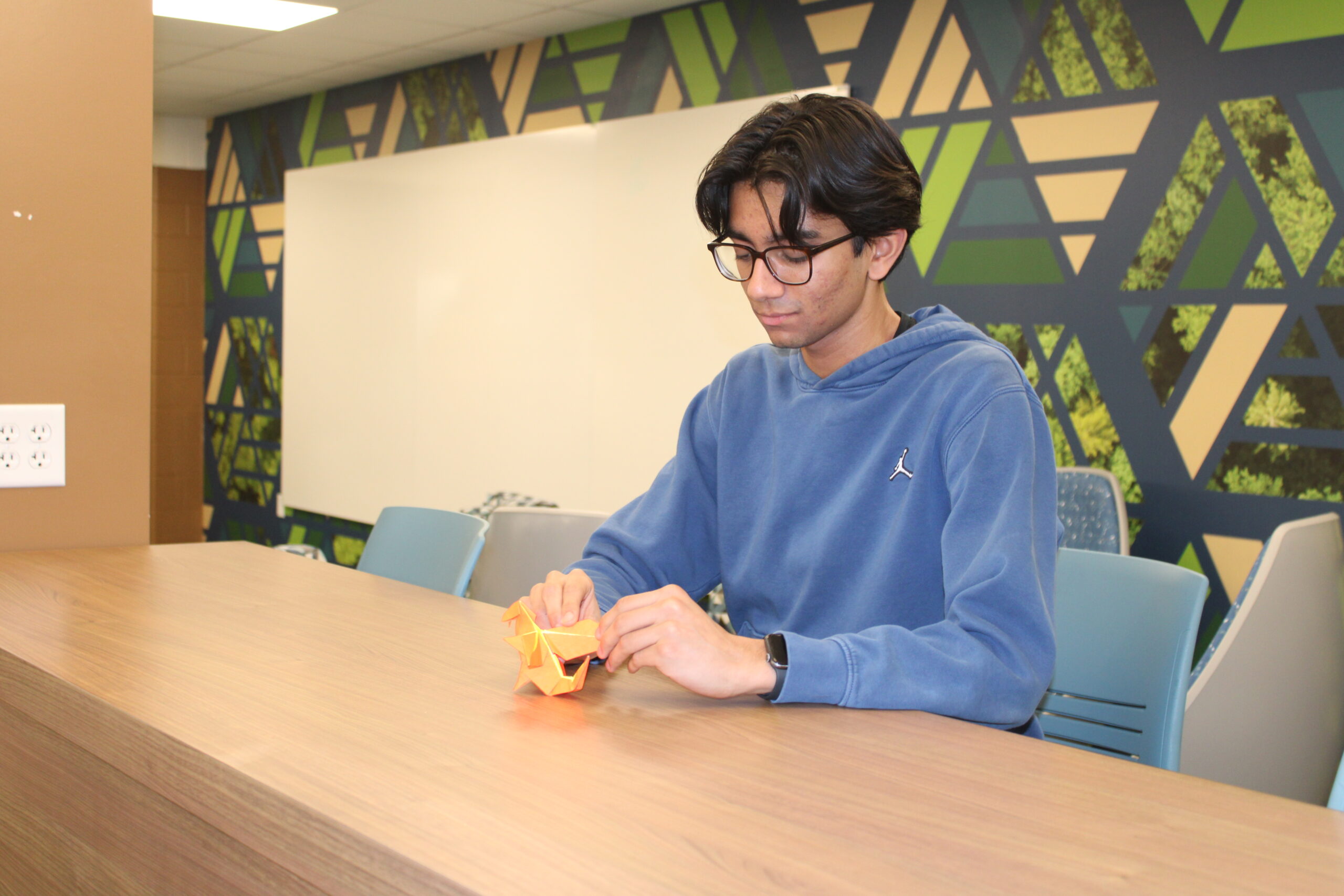
From painting to dancing, Mason High School students are constantly finding new ways to express themselves through art. Many students begin their artistic journeys via classes, but MHS junior Ojas Parekh started with one sheet of paper.
At age six, Ojas began learning origami with his father from books and the internet. In elementary school, he expanded his origami skills by taking on larger, more ambitious projects. As Ojas became more involved with the origami community, he started to participate in art fairs, conventions and other outreach activities.
Ojas began experimenting with abstract origami before moving on to creating his own designs and patterns. Ojas said that different people have preferences for styles and designs.
“Bigger projects do take a lot of time [so], I like designing simpler things I can share the joy of and teach to other people,” Ojas said. “[Folding sea creatures] is really interesting because it’s just fun to figure out how to make that kind of design efficiently.”
Ojas said that he was fidgety growing up, but origami has taught him both personal and academic skills that help in his everyday activities.

MHS junior Ojas Parekh has attended events such as OrigamiUSA and OrigamiMIT with his origami displayed in the Cincinnati Kirin Gallery.
“[Origami] has taught me patience and the ability to calm down [while] focusing on something,” Ojas said. “Another important thing that origami has given me is visual geometric and problem-solving skills, [which have made] learning math, physics and geometry a lot easier.”
Ojas is not the only one who recognizes the benefits of origami. His father, Chetan Parekh, said he has seen how the activity has shaped Ojas’s work ethic and character.
“Origami has taught Ojas persistence and humility,” Chetan said. “[Like] how to start over when a fold goes wrong, and how progress comes through quiet, sustained effort. We’ve seen his confidence grow and his mindset mature as he’s learned that beauty and structure emerge from discipline and patience.”
Now reaching his tenth year of creating origami, Ojas said his father’s role in the hobby has allowed them to connect over a shared activity and has helped him develop his own creative path.
“We bonded a lot over making fun things and memories,” Ojas said. “Because I was six years old and needed a little bit of guidance, he was always just there to help me. [Slowly], I started outgrowing my dad and getting into [origami] communities, contacting people and learning how to design stuff for myself.”
At age 10, Ojas attended his first OrigamiUSA convention. He became involved in volunteering in nursing homes and showcasing at art fairs such as the Cincinnati Kirin Gallery as he continued exploring opportunities with origami. Chetan said that the process from simply learning the art to outreach has changed his role in Ojas’s origami journey.
“As he grew older, [my] role shifted to enabling,” Chetan said. “Giving him more space to explore, access to more complex resources and getting him connected to organizations like OrigamiUSA where he could have the chance to share his work and learn from others.”
As Ojas continued origami through middle school, he began designing and creating his own projects. Ojas said that the two main challenges that come with large projects are staying motivated and dedicating lots of time.
“So I began to pivot into my own path [of] designing and teaching,” Ojas said. “That played into the motivation part. Since I could actually make something myself, and not only feel really good about it, but also teach others how to make things for themselves.”
Ojas began attending conferences such as OrigamiMIT and lecturing about the craft in his freshman year. He said that these experiences allowed him to meet people of all ages and backgrounds.
“Finding a community can be really hard,” Ojas said. “At these conventions, I’ve stepped out of my comfort zone by reaching out to these people that I wouldn’t have if not for origami. If I didn’t have friends who have seen and talked to me about origami, I don’t think that I would have found as much motivation to keep going with this community and this art.”
Through lecturing at conventions, Ojas said he has strengthened his public speaking and communication skills. In high school, he also began creating his own summer camps and helped establish a Junior Board within the OrigamiUSA program to make origami more accessible to younger audiences. He said these experiences have given him a new perspective on the hobby and on himself.
“I get super nervous putting myself out there and talking to a group of people,” Ojas said. “But teaching kids and trying to be confident in front of all these people, because in these scenarios, I’m the one teaching. They’re the ones looking up to me, so it makes me feel amazing about just being there and doing my best in front of them.”
Ojas said the people he’s collaborated with from teaching origami motivate him to continue outreach work because of their emphasis on spreading the community.
“The most rewarding part [of teaching] is just seeing myself in them and that spark that I had when I was little,” Ojas said. “[As well as] seeing how they respond and how they can learn from the benefits of the art. We are so close-knit. We care about spreading the culture, uplifting, teaching and making sure everybody’s having a good time.”
Currently, Ojas is developing a mathematics curriculum with the University of San Diego to incorporate origami into in-person programs. As he continues exploring his passion for origami, Chaten said that watching how origami impacted Ojas gives him confidence about the future.
“Our hope is that Ojas continues to pursue what genuinely fascinates him,” Chaten said. “Origami doesn’t need to be his destination. But we believe the habits it has built will stay with him. Origami will always be part of the foundation that taught him how to think, focus and find meaning in the process itself, not just the outcome.”