

Ruhi Kaneria | The Chronicle
Allison Keim | Editor-in-Chief | The Chronicle
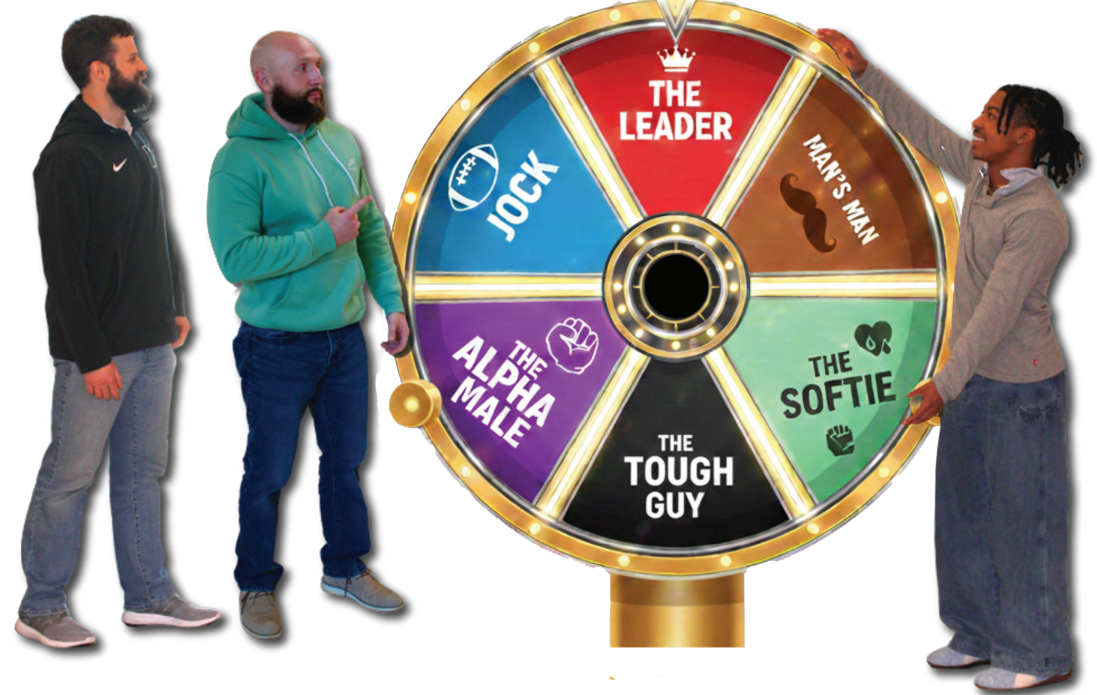
Young men face a mirror of expectations, reflecting both who they are and who society expects them to be.
The Merriam-Webster Dictionary defines masculinity as “the quality or nature of the male sex.” For students and staff at Mason High School (MHS), the concept of masculinity is defined by their upbringing, experiences and socialization.

Mental health challenges and vulnerability
Many students, staff and parents in the Mason community are aware of the rising concern in teens’ mental health. There are conversations about differences in how female and male students discuss vulnerable topics, such as mental well-being. MHS senior and Hope Squad member Taurien Wiggins, has witnessed how young men converse about their mental health issues.
“The biggest difference I see is that men tend to joke about their mental health when they are actually struggling,” Wiggins said. “I find that women often feel more comfortable sharing that they are struggling, when men will steer you away from it, instead of just opening up.”
Wiggins points out that much of this behavior stems from reinforced ideas of strength that a man should exude.
“[Some stereotypes are men] not showing their emotions or not being a crier,” Wiggins says. “[Ideas of] trying to be overly strong, or trying to be the best in sports, push those abnormal expectations.”
Advanced Placement (AP) Psychology teacher, Hope Squad advisor and assistant MHS football coach, Alex Beurket, similarly notices that male students can feel uncomfortable opening up to one another. He points to the team’s head coaches for leading heartfelt conversations about their own lives, building trust on and off the field.
“I try to demonstrate [to the players] that being a man or being masculine doesn’t mean that you are always strong or that you don’t have hardships,” Beurket said. “You can ask for help or express pain or challenges that you’re facing.”
Whether young men are on the court or in the weight room, many male staff members hope to support them through their journey with identity. MHS Director of Sports Performance, Trent Smart, said he motivates athletes to remain focused in the weight room no matter their demeanor when they enter. This is achieved by limiting distractions, including social media apps and texting.
“It is very obvious to see when people are having good days and bad days based on their body language when they walk into the weight room,” Smart said. “The beautiful thing about our weight room is that it is an outlet. You get 45 to 60 minutes to step away from your life. I do see people walk in dealing with things and release that via barbells, dumbbells and bumper plates.”
Impact of gender expectations on behavior
Many of the stereotypes surrounding how men should act are developed by factors in their lives. AP United States government and politics, government and world history teacher Maria Mueller uses her grasp of American history to explain where these complex issues have stemmed from.
“I would suggest that society still defines masculinity in a very traditional way,” Mueller said. “Some of it has to do with expectations of being strong, whether that be physically or emotionally.”
Wiggins was a team captain for the football team during the past fall sports season. Having the role of supporting the growth of his teammates, he saw how the “jock” mindset affects the way young players behave.
“People kind of have this mindset about football players that they are aggressive and not good at school,” Wiggins said. “Those kinds of pressures make football players feel the need to overcompensate or fall into the stereotypes. It is about teaching them that they do not have to fall into a box anyone puts them in.”
Sports locker rooms are typically identified as the space where teams build chemistry and get amped up for athletic performances. This is a private space for teammates to bond, but with that, Wiggins acknowledges that shame and competitiveness exist within the walls.
“Locker room culture becomes toxic when you are not having the right conversations,” Wiggins said. “When [the environment] is about brotherhood and family, it can build up a positive [culture] and not a negative one.”
Although some might believe that the idea of masculinity is definitive, Beurket has hope that its meaning can develop over time.
“Masculinity and femininity are cultural concepts,” Beurket said. “We have the opportunity to continue to shift and change them as we all age, changing the narrative as we go forward. I hope [one of those] is regarding the stigma around mental health for every person, because we know that it is not just men. Young men might struggle with things differently than young women, but it affects all of us.”
Pressure in sports and body building
For many young high school men, ideas about masculinity are reinforced daily through participation in sports. Through competitions, physical training and team expectations, fields and courts become a space where manhood is shaped.
Having participated in football, Wiggins understands the pressure that comes with performance while on the field. Even off the field, Wiggins has noticed that people, whether in a sport or not, feel the need to keep up a certain body image to be seen as attractive or fit.
“We see a lot of men gravitate towards gym culture because they want to be seen as strong or empowered,” Wiggins said. “There is something empowering about going to the gym, but you should be doing it for yourself and not for the outlook of others.”
Like Wiggins, Beurket also played football in high school. He acknowledged that playing football, a prototypical masculine sport, shaped his identity in terms of strength and responsibility while on the field.
“I do not remember ever hearing a coach tell me, ‘Be a man’ or ‘don’t be a woman’,” Beurket said. “But there was always an underlying [message] emphasizing toughness among men.”
Beurket reflects that the expectations do not occur just on the field, but in everyday athletic spaces. While coaches like Beurket do not expect a certain version of masculinity, he notes that the culture of sports creates one through comparison of body image and performance. Beurket sees this translate into athletes during training.
“You go to the weight room, and you see young players who are trying to develop and get stronger,” Beurket said. “They think about themselves compared to someone else as ‘the lesser than’ type just because they don’t look the part.”
Instead of allowing their image to define an athlete’s capacity, Smart offers a holistic perspective on being in the weight room.
“There [are] so many other areas and so many different aspects of your life that you are good at and that you can invest in on top of being an athlete, so when you have to hang up the cleats or hang up the clubs, you have something else to lean on to dive into,” Smart said. “I want my athletes to do well in the weight room, but I want them to take the qualities I teach, such as discipline, commitment and consistency, and apply that to the rest of their life, whether it is [in] a classroom, at home [or] helping out mom and dad.”
Finding guidance from mentors
Role models play a critical role in how men develop their masculinity, identity and character. The presence or absence of strong male figures can influence what standards and societal expectations boys internalize and the examples they choose to follow.
“I would say Mr. Beurket [is my male role model],” Wiggins said. “I always inspire myself to be the best man I can with how calm his voice is and how empowering [he] is.”
As a mentor, Hope Squad advisor and coach, Beurket embodies steady leadership for younger men. Beurket, however, understands that not every young man has access to a male role model at home, often shifting the search for guidance elsewhere.
“I would imagine from what I know, study and teach [that] if you don’t come from a two-parent household, more often than not, that one parent is a female,” Beurket said. “So young men who are growing up without a dad are looking for male figures in society [to represent what it] means to be masculine. Hopefully, we know that celebrities and social media and movies are fake, but if that is who young men are looking for to tell them what it means to be a male, they are going to have a very distorted view of masculinity that is made by the media, not made by real people who are living with them.”
Influence of online communities
Recently, the term “manosphere” has floated around youth and can be identified as a collection of online communities and influencers that promote a particular, often rigid, idea of what masculinity is. Through podcasts and social media, these spaces may claim to offer guidance on what it means to be a man, but may actually reinforce harmful stereotypes.
Beurket points out that teenagers are not the only ones vulnerable to misinformation online. He has witnessed older generations being overly trusting when it comes to what they view online. He is an advocate for media literacy and people making informed decisions. Still, he emphasizes that adolescents are especially susceptible.
“[Teens] are still figuring out who they are and forming their identity,” Beurket said. “They are looking for people to be their model or their leader. So [it is important to] think critically about things and not take things for truth just because you see it.”
As a younger male online, Wiggins emphasizes being aware of the sources. He stresses that students have to be educated when interacting with online communities.
“Make sure you are not getting fed false information and enforcing those harmful stereotypes,” Wiggins said. “[It’s important to find] a medium ground and do your own research.”
Sociology and history teacher Gabriel Wigginton also sees the dangers of teenagers forming opinions based on what they see online. He believes that technology has changed how people interact with their friends and family.
“With social media and with parenting, I have seen less time [in teenagers] being spent with the family, so they’re getting more influenced by outside sources instead of the family unit,” Wigginton said. “Depending on the student you have, that is going to dictate the changes of where they get their masculinity from. If it is coming from the internet and the movies and the music, you see kids that want to be these fake tough guys.”
Through his “Service Learning Assignment”, Wigginton encourages his sociology students to experience a different culture or set of beliefs. He believes that exposure to a variety of viewpoints helps prevent students from being trapped in one perspective.
“That’s why I encourage kids to, [regardless of] what political party you’re on or what side of the view you’re on, always try to expose yourself to the opposite side,” Wigginton said. “That will change not only your feed, but also change your perspective, so you are not just getting pigeonholed into one viewpoint and being puppeted.”
Mueller adds a historical perspective, noting that before the internet, people typically got their news and information from encyclopedias, television, radios, friends and family, a range that is very different from the 24-hour news cycle that has developed in the digital age. She notes that the presidential elections also shifted in the early 2000s due to the abundance of news being shared with voters.
“As someone who teaches government, it is important because democracy relies on the people to make informed decisions,” Mueller said. “If the people are not making decisions that are informed with accurate information, then they are making choices that are not based in reality.”
As young men grow and develop their sense of identity, both Mueller and Wiggins suggest that there is no typecast of a man. With the pressures of mental toughness, social media and body image, Wiggins hopes that his male peers understand that vulnerability can be redefined as a strength.
“There’s no definition of a real man,” Wiggins said. “Being yourself and being who you are is being the best man you can.”




2 thoughts on “Redefining strength, masculinity as new generation finds its voice”
Comments are closed.