
Michelle Zuo | The Chronicle
Swords have long symbolized strength, power and honor in stories and history. However, fencing has turned the weapon into more than a symbol, combining focus, discipline and strategy.
Although fencing is a lesser known sport, Mason High School (MHS) has offered a fencing club since 2006, when coach Ryan Howell, who also coaches at Salle Du Lion Fencing Club started it. Many MHS students partake in other fencing clubs but find extra training time in the school club.
Sophomore Irum Hussain began sabre fencing in seventh grade and now participates in both the MHS and Salle Du Lion fencing clubs. Hussain said she began fencing as a way to help manage her Functional Tic-Like Behaviors (FTLBs).
“My mom thought [fencing] would help with my concentration since fencing is very focus-oriented,” Hussain said. “Once I got into the fencing mindset, I was so focused that my tics didn’t have time to manifest [so] it dissipated over time.”
Fencing has three main disciplines: sabre, foil and épée. Each differ in scoring, target areas, technique and sword material. Hussain mainly fences sabre, which she said she enjoys because of its flexibility in target areas and material.
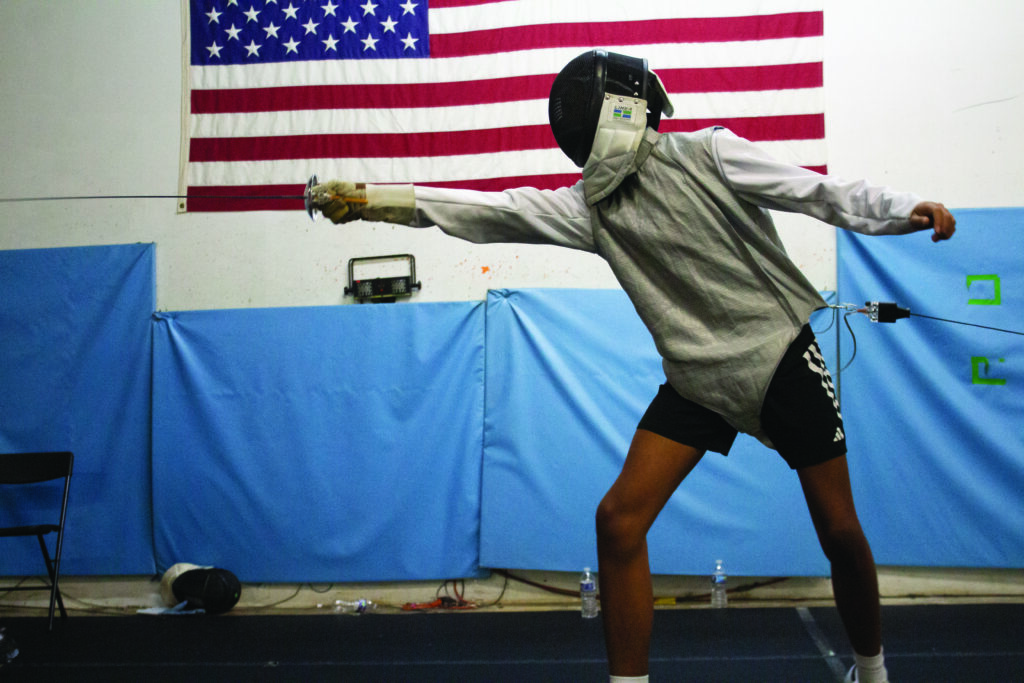
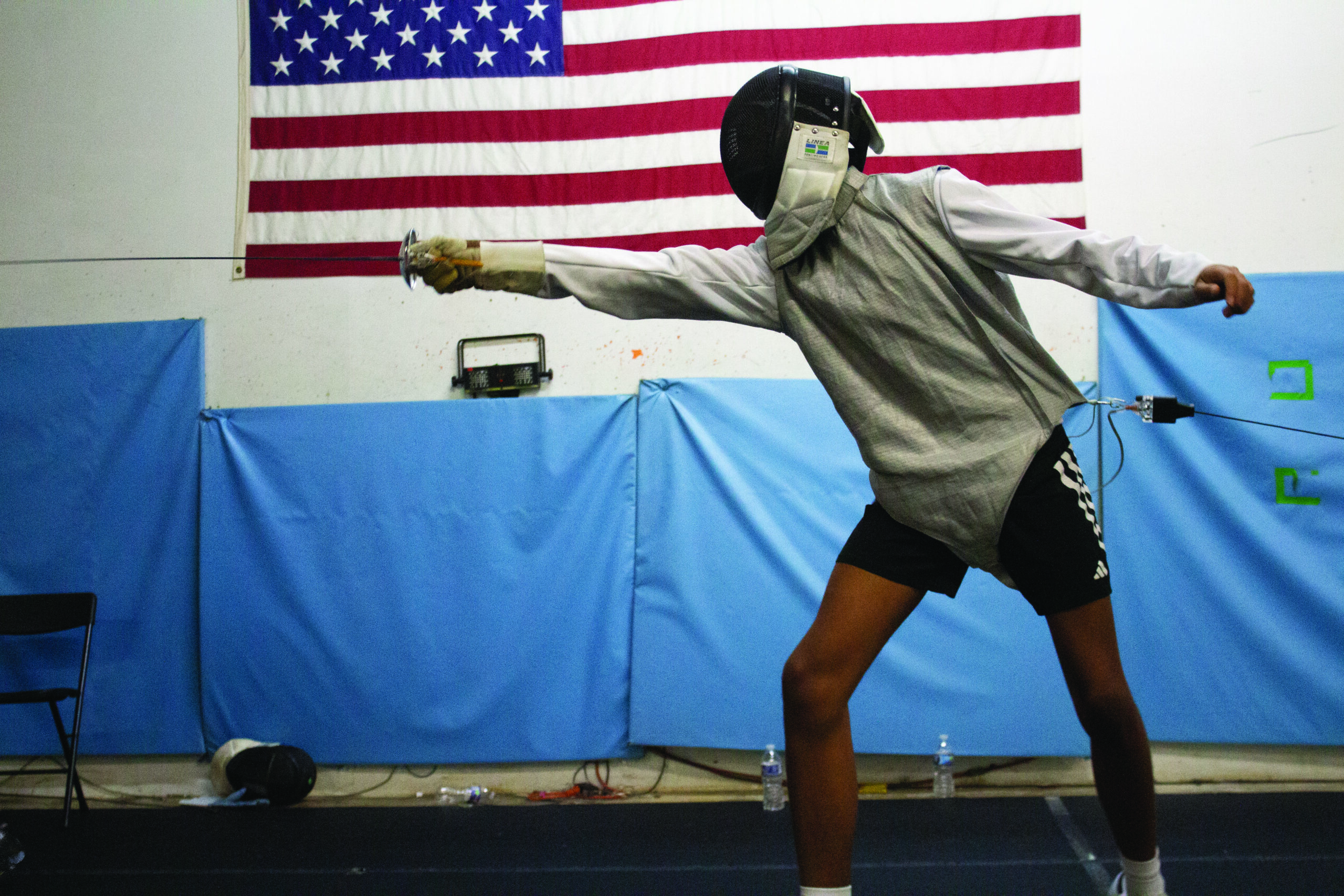
Sophomore Austin Blake lunges for his opponent at Salle Du Lion Fencing club during his training on October 28.
“Sabre looks like a classic sword and is more bendy,” Hussain said. “There’s less rules and you can touch more spots such as torso, arms and head. Foil is a lot stricter [and the judges] pay more attention because the touches [are just] torso and head.”
Sophomore Davian Kauffman has fenced for eight years, and has experience with both foil and sabre. However, Kauffman said he primarily fences sabre because of its bigger target and swing-based technique.
“[Fencing is] a very active sport,” Kauffman said. “When I first started [fencing] I was terrible and I couldn’t get a single win and no one precisely taught me how to react fast, Over time, I just built that knowledge up and adapted.”
Sophomore Austin Blake specializes in foil. Blake began fencing three years ago and also participates in the MHS and Salle Du Lion Fencing clubs. Although fencers typically remain with the discipline they first learn, Blake said he prefers foil because of its stricter guidelines and emphasis on accurate hit points.
“Foil is a lot more transferable than sabre because there’s a level of precision in foil that doesn’t exist in sabre,” Blake said. “Foil is more contemplative and detailed because it’s more about trying to get the other person to mess up. At that point, [fencing] turns into a mind game.”
Instead of having a limited target area sabre and foil, épée’s target area spans across the entire body. Although Blake’s coach teaches épée, Blake said there isn’t a heavy emphasis on épée throughout Southwest Ohio because of the target area’s impact on the style of the discipline.
“[The match] becomes a standoff when you pair [épée’s target area] with fast moving swords,” Blake said. “No one wants to get hit, [so it gets] boring.”
Blake said that the main challenge with foil is a combination of the different aspects throughout the bout. A bout is the term for a match in fencing.
“All the forms and bladework [of fencing] are really precise and you need to focus on hitting in the proper manner,” Blake said. “There’s small rules you need to keep track of [and it’s] a lot of little things that pile up.”
One of the obstacles with fencing that Hussain has faced is the limited facilities, competitions and training. She said that the male-dominated aspect of fencing is also something she’s learned to overcome.
“[Fencing is] less marketed towards girls and it’s more accessible for guys,” Hussain said. “Girls have to wear chest guards when they fence, [so] you have to pay extra money for that plate. But I like it because I can’t feel anything when [the sword] hits me [since] the hits are quick and almost feel like a whip.”
Despite these challenges, Hussain said fencing gives her a goal outside academics. She said she also finds encouragement in her teammates and the competitive environment.
“It’s fun being one of the only girls because you’re underestimated and it makes the win more satisfying,” Hussain said. “My team feels very brotherly to me and it’s mutual [since] if you do well, they do well and it helps both of you in the long run.”
Blake said fencers must decide whether to rely on familiar techniques or try new approaches. Hussain said taking account of the opponent’s perception of movement is another aspect of this mental decision.
“People call [fencing] the chess of sports and it’s because you have to know and get the muscle memory for moves,” Hussain said. “[The opponent] will always be calculating what you’re doing next. That also means you can’t have a style because they’re going to catch on.”
Blake said he has learned how to manage his nervousness by concentrating on the sport’s technical demands. Kauffman, meanwhile, said losses have taught him to identify weaknesses and use practice to address them.
“Knowing that I can do better always gets me and bothers me [when I lose],” Kauffman said. “[But], I always know there’s another time and it’s not a once-in-a lifetime-thing. You have to keep losing until you figure out how to start winning. [So], I would try to focus on what I’m bad at when I train.”
As she continues fencing, Hussain hopes to fence throughout high school and into college. She said the persistence and work ethic she has developed through fencing to achieve her goals outside of the sport.
“Tournaments are like an academic test and I like seeing my hard work pay off,” Hussain said. “I like having something to work towards and it helps with persistence in school. [Fencing] is like studying a skill that doesn’t come easy for you; if you put in enough work, you will get it.”