
Suhani Datta | The Chronicle
Many teenagers spend their summer swimming in the pool, going to Kings Island or watching movies at the cinema. For Mason High School (MHS) sophomore Saanvi Ramachandran, summer was spent in a constant loop of writing, modifying and pacing in circles.
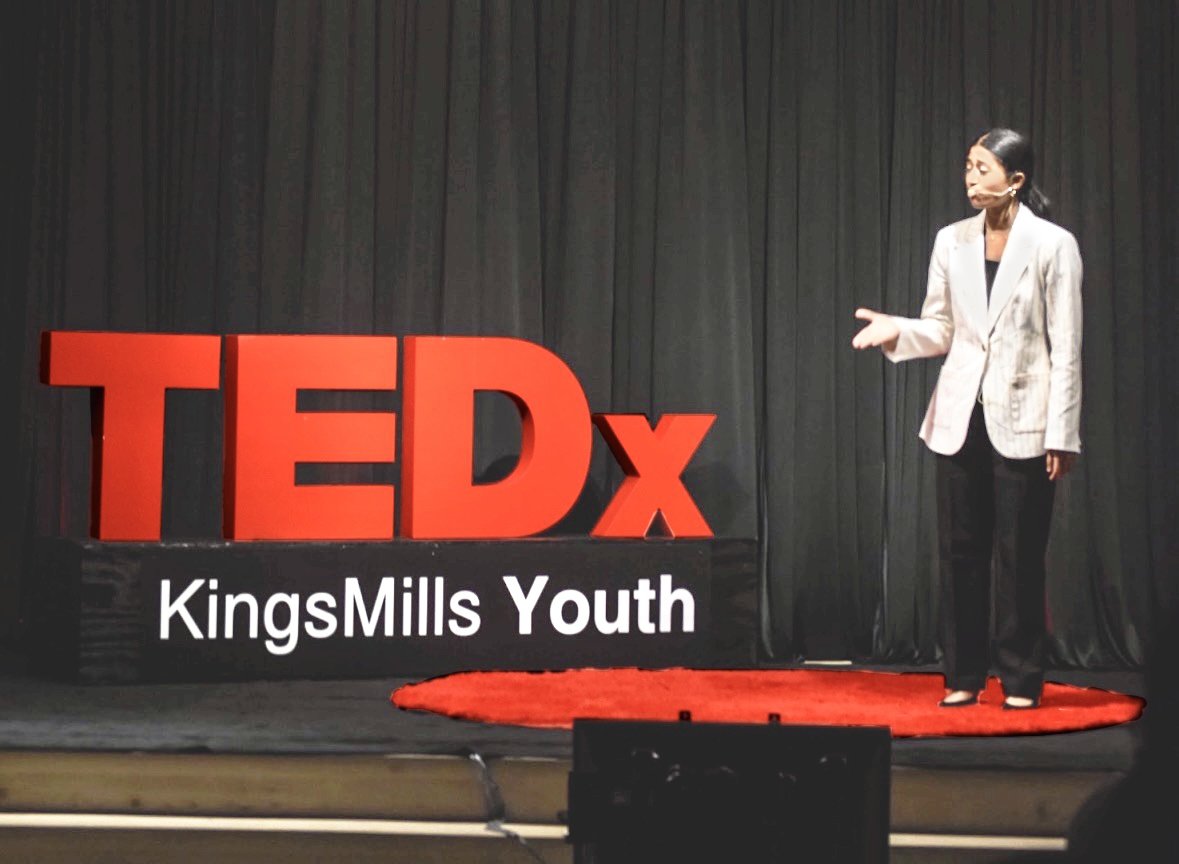
On July 25, Ramachandran delivered an eight and a half minute speech at TEDx Kingsmill Youth, an independent event focused on highlighting underrepresented voices. TEDx events are organized by individuals who want to spark conversation and community in their local areas about new ideas and research.
Ramachandran said that giving a TEDx speech has been a long-time goal for her, applying to events for the last year and a half. She said this aspiration stemmed from her love for meeting new people and giving speeches. She said that coming up with a short, conversational topic for her talk was a vital first step in the speech writing process. Her inspiration came from a diagnosis of her father’s neurological problem, a tremor that caused her to observe the unpredictable nature of life.
“He’s all good now,” Ramachandran said. “But [the diagnosis] made [me] question the purpose of life [and] how to accept this big change because now, he’s getting slower [and] it’s getting harder for him to do things.”
After Ramachandran’s message was finalized, she said there were still more obstacles for her to overcome. She said breaking into the adult-dominated scene proved to be a massive challenge.
“I was the only person [speaking at the conference] who was a high school student,” Ramachandran said. “There were physicians [and] people who spoke from pretty much all around the world, so [that] was really difficult. I had to build credibility from how well I spoke.”
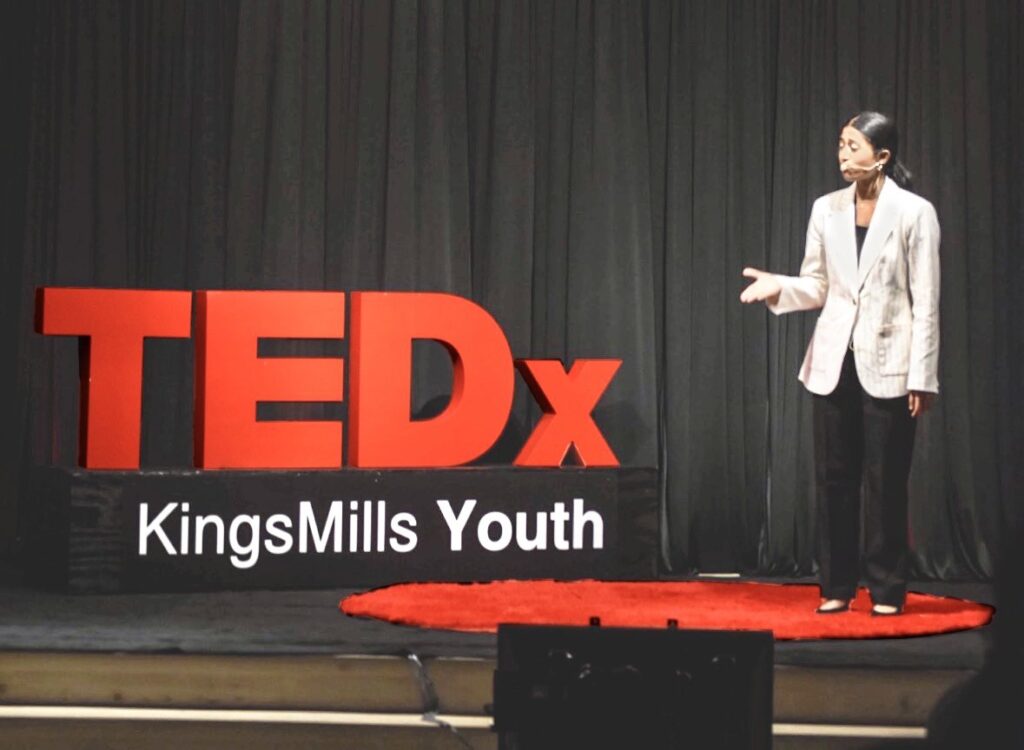
Saanvi Ramachandran discusses how to approach change positively in her speech at TEDx KingsMill Youth on July 25.
Ramachandran said that her time on the MHS Speech and Debate team competing in the Original Oratory division gave her the skill set necessary to go through with this undertaking. Original Oratory, an event where competitors write and memorize a 10 minute persuasive speech on a societal issue, is also where Ramachandran met her mentor and friend, senior Amruta Puntambekar. Puntambekar said she saw Ramachandran’s drive early on and helped her refine her approach.
“I’ve always appreciated the fact that Saanvi is an [extremely] determined person,” Puntambekar said. “She is an incredible natural speaker. It was [amazing] seeing her take what she was learning in Original Oratory and put that into a much more real-world setting.”
To build the credibility required for a TEDx stage, Puntambekar said she advised Ramachandran to ground her personal narrative in concrete research. Puntambekar said these hard facts are integral for the speech to be persuasive.
“When you’re giving a speech that’s personal to you, it can be easy to try and convince your audience purely on that emotion,” Puntambekar said. “But it’s really important that you bring some kind of external validation.”
Ramachandran said that external validation came from her experience volunteering in hospitals and her research in neuroscience from medical journals. One psychologist in particular was fundamental in her speech, his famous saying serving as the scientific explanation behind how human brains process change.
“I ended up reading [journals by] this famous neuroscientist Donald Hebb,” Ramachandran said. “He has a common quote that everyone in the medical world knows: ‘Neurons that fire together, wire together.’ What that means is in our brains, we have different neural pathways that influence how we think, and because that influence happens, that’s why we think [the way we do].”
Once Ramachandran had her speech finalized, a rigorous preparation routine began. Ramachandran practiced giving her speech for around 72 hours in total. Ramachandran said this exhaustive ritual paid off the day of the event, when her pre-stage anxiety was replaced with self-assuredness. When she finally stepped off the stage, she said she was able to witness the emotional payout of her hard work.
“I delivered the speech so well that the audience was crying, bawling their eyes out,” Ramachandran said. “But when I was on stage, I had no clue what was happening. I was just speaking.”
In the sea of people in the audience at the conference sat Dr. Richard Van Dyke, Ramachandran’s long-time piano teacher. Ramachandran said that Van Dyke’s attendance was especially meaningful to her.
“I invited him to my speech because he’s a mentor to me,” Ramachandran said. “He’s been with me since kindergarten. He’s the type of piano teacher to [say], ‘Play this again, you suck.’ He’s straightforward, and he doesn’t want people to feel full of themselves.”
After Ramachandran concluded her speech, she said that a moment with Van Dyke showed her the effect of her words. Van Dyke approached Ramachandran to congratulate her and displayed a reaction she said she hadn’t expected.
“He gave me this big hug, and he was sobbing on my shoulder,” Ramachandran said. “In that moment, I just knew I did impact somebody. Even if it’s just one person who goes to bed tonight, thinking, ‘This girl actually did something,’ I’ll take it.”
Ramachandran said she had already applied to two TEDx conferences before landing a spot at Kingsmill. She said her rejections, rather than discouraging her, motivated her to keep trying.
“Every single time I got rejected, for sure I was bummed,” Ramachandran said. “But more than that, I thought, ‘There will be a point where someone will pick a high schooler who will give a TED talk, and that high schooler will be me.’”
Now, having achieved her goal, Ramachandran said she plans on continuing to refine her public speaking and use these skills in the medical field. She said she hopes her journey encourages other students to push past their fear of failure.
“Every single rejection you have is [an] opportunity that you are given,” Ramachandran said. “We don’t think we can do a lot of these things, but you don’t know what you can do until you give it a try.”